
Medigap Rate Increase? What to Do Before You Switch
Medigap Rate Increase? What to Do Before You Switch: The Short Answer
A Medigap rate increase doesn’t mean you must switch. Check whether your policy is community-, issue-age- or attained-age-rated, then compare the same plan letter from other insurers, a lower-premium plan, or a state birthday right. Outside those rights, insurers can ask health questions, so keep your current policy until a new one is approved.
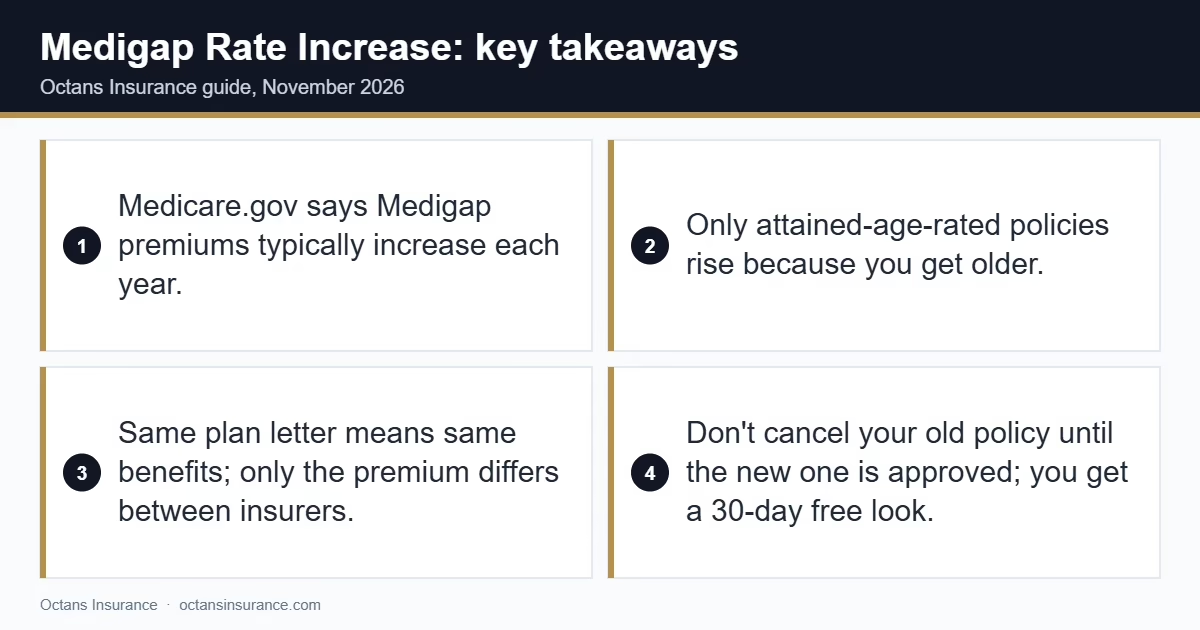
- Medicare.gov says Medigap premiums typically increase each year.
- Only attained-age-rated policies rise because you get older.
- Same plan letter means same benefits; only the premium differs between insurers.
- Don’t cancel your old policy until the new one is approved; you get a 30-day free look.
Table of Contents
Make sure your family is financially protected today!
A Medigap rate increase letter doesn’t mean you must switch. First, learn how your policy is priced and why the rate rose. Then compare the same plan from other insurers, a lower-premium plan, or any state birthday right. Outside those rights, expect health questions, and never cancel your policy before a new one is approved.
Why a Medigap rate increase happens
Can Medigap premiums increase? Yes, and most do. According to Medicare.gov, premium amounts typically increase each year. Each insurance company decides how it sets its own prices.
Increases usually come from rising health care costs and inflation. Depending on how your policy is priced, your age can also be a reason. States review these increases. Under the NAIC model Medigap regulation, an insurer may not use or change Medigap premium rates unless they have been filed with and approved by the state insurance commissioner. Each state adopts its own version, so details vary.
Community, issue-age and attained-age pricing
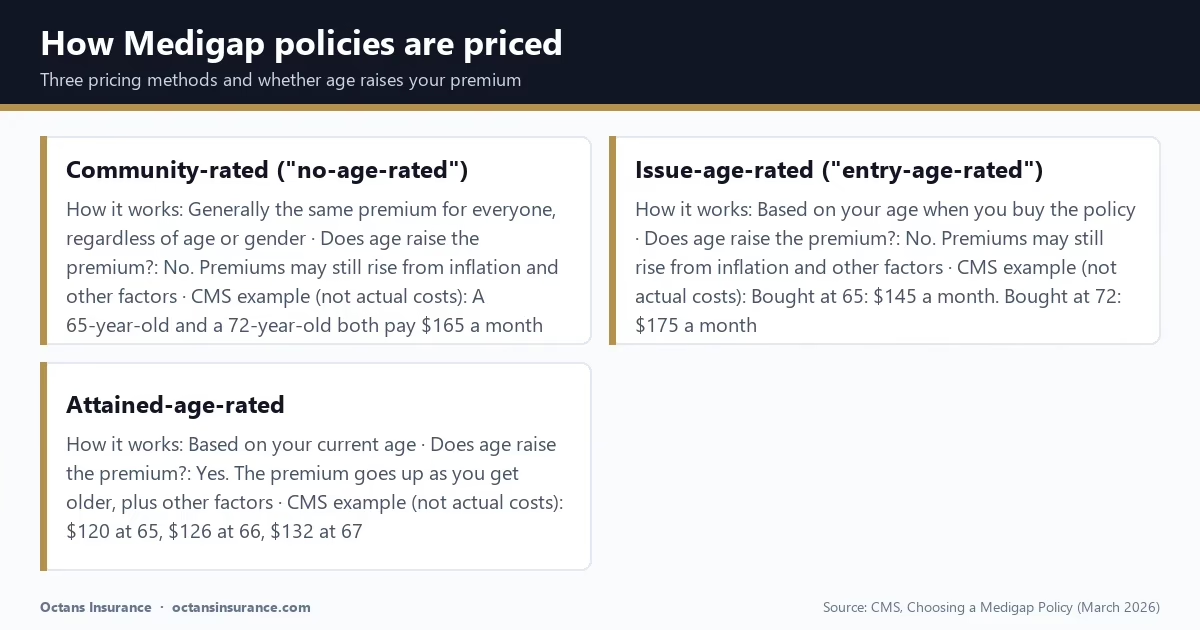
How are Medigap premiums determined? The CMS guide to choosing a Medigap policy says each policy is priced in one of three ways. The method matters because it shapes what you’ll pay as you get older.
| Pricing method | How it works | Does age raise the premium? | CMS example (not actual costs) |
|---|---|---|---|
| Community-rated (“no-age-rated”) | Generally the same premium for everyone, regardless of age or gender | No. Premiums may still rise from inflation and other factors | A 65-year-old and a 72-year-old both pay $165 a month |
| Issue-age-rated (“entry-age-rated”) | Based on your age when you buy the policy | No. Premiums may still rise from inflation and other factors | Bought at 65: $145 a month. Bought at 72: $175 a month |
| Attained-age-rated | Based on your current age | Yes. The premium goes up as you get older, plus other factors | $120 at 65, $126 at 66, $132 at 67 |
So do Medigap premiums increase with age? Only with attained-age pricing, by design. The CMS guide notes attained-age policies may be the cheapest at first but can eventually become the most expensive. Where you live, medical underwriting and discounts can also affect your premium.
How to read your Medigap rate increase letter
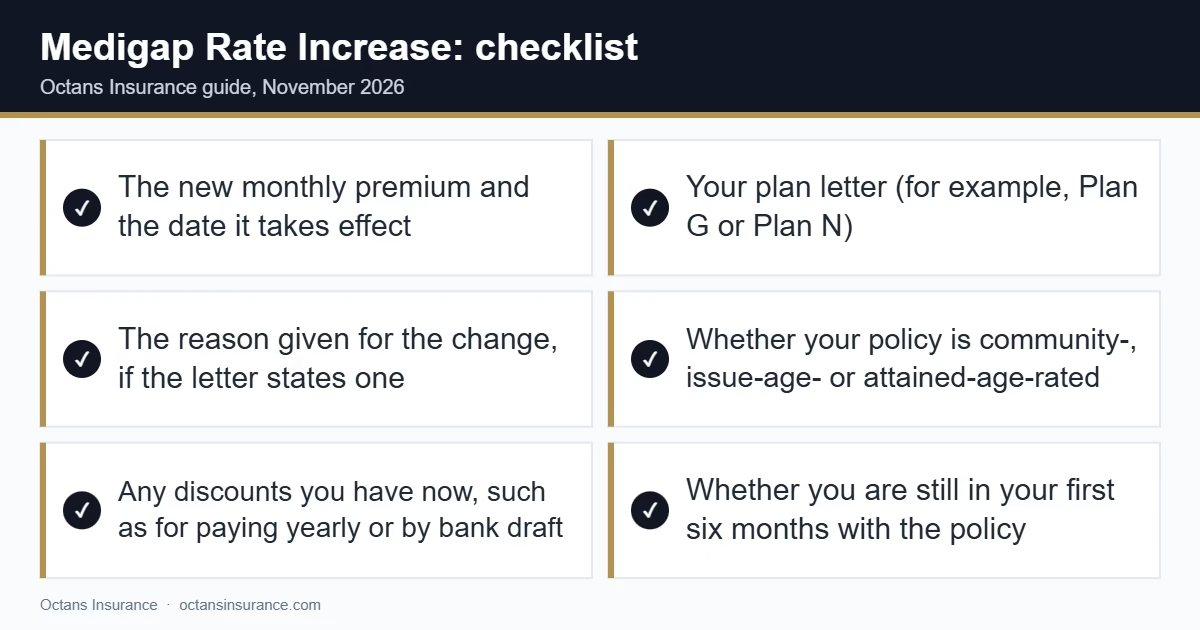
Before you shop, pull out the letter and your policy. Look for these details:
- The new monthly premium and the date it takes effect
- Your plan letter (for example, Plan G or Plan N)
- The reason given for the change, if the letter states one
- Whether your policy is community-, issue-age- or attained-age-rated
- Any discounts you have now, such as for paying yearly or by bank draft
- Whether you are still in your first six months with the policy
If the pricing method isn’t on the letter, call the insurer and ask. The CMS guide suggests asking how often an attained-age premium rises because of age, and whether the premium has gone up in recent years.
Also ask about discounts you may not be getting. The CMS guide says some insurers offer discounts for women, non-smokers or married people, for paying yearly or by electronic funds transfer, or for having more than one policy. A discount won’t stop future increases, but it can soften this one.
Option 1: The same plan from a different insurer
Medigap plans are standardized. The CMS guide explains that the benefits in each lettered plan are the same no matter which company sells it. The premium is the only difference between policies with the same plan letter.
That makes this the cleanest comparison after a Medigap rate increase. You keep identical benefits and only change the price. But premiums for the same plan can vary widely by insurer, and a lower price today says little about future increases.
For example, say your Plan G premium rises from $180 to $207 a month. That is a 15% increase ($27 divided by $180). Over a year, you’d pay $324 more ($27 times 12). A Plan G quote from another insurer at $185 a month would cost $22 a month less, or $264 a year less, if you’re approved. These numbers are only an illustration.
Option 2: A plan with a lower premium
It depends on how you use your coverage. Moving to a plan with fewer benefits, such as Plan N instead of Plan G, usually lowers the premium. In exchange, you take on some costs yourself, like certain copays. Our Plan G vs Plan N guide walks through the trade-offs.
Another choice is a high-deductible version of Plan F or G. According to the CMS guide, you pay the first $2,950 (in 2026) of costs before the policy pays. That amount changes each year.
Some people also look at Medicare Advantage during Open Enrollment, which ends Monday, December 7. Weigh that carefully. The CMS guide warns that if you drop Medigap to join a Medicare Advantage plan, you may not be able to get the same policy, or any Medigap policy, back later.
Using a birthday rule or another state right
There is no federal birthday rule. Some states give you a yearly window to switch without health questions. Our Medicare supplement birthday rule guide lists the states we’ve confirmed on official sources, and each state’s rules differ.
Two examples show how much they vary. The California Department of Insurance describes a 60-day window starting on your birthday to switch to a plan with equal or lesser benefits. Oregon’s Division of Financial Regulation uses a window from 30 days before to 30 days after your birthday, for the same or lesser benefits.
Birthday rules let you move to equal or lesser coverage, not upgrade. Massachusetts runs its own Medigap system, explained on our Massachusetts Medicare supplement page. Check your state insurance department before acting.
When you’ll face health questions
In most cases, there is no federal right to switch Medigap policies. The CMS guide says that right exists only during your six-month Medigap Open Enrollment Period, which starts the first month you have Part B and are 65 or older, or when you qualify for a guaranteed issue right. Otherwise, insurers can use medical underwriting and may turn you down.
There is some protection on pre-existing conditions. If you’ve had your current Medigap policy for more than six months and the new policy has the same benefits, the new insurer can’t exclude your pre-existing conditions or make you wait. If the new policy adds a benefit you didn’t have, you may wait up to six months for that benefit. Our Medigap underwriting guide explains the questions you may see.
Don’t cancel until the new policy is approved
This step protects you from a gap in coverage. According to the CMS guide, don’t cancel your first Medigap policy until you’ve decided to keep the new one. On the application, you’ll promise to cancel the old policy, but only after you’re approved.
You get a 30-day free look period after receiving the new policy. You’ll pay both premiums for the month you have both. Once you cancel the old policy, you can’t get it back. A Medigap rate increase is frustrating, but a careful switch is better than a fast one.
Keep Reading: Related Guides
- Medicare supplement birthday rule by state
- Medicare supplement underwriting
- Medicare Plan G vs Plan N
- Medigap birthday rule calculator
- Do Veterans Need Medicare Part B? VA vs Medicare Costs
- What Vaccines Does Medicare Cover? Part B vs Part D
Medigap Rate Increase? What to Do Before You Switch: Frequently Asked Questions
Can my Medigap premium go up every year?
Yes. According to Medicare.gov, Medigap premium amounts typically increase each year. Increases can come from inflation and rising health care costs, and attained-age policies also rise as you get older. States review Medigap rates, and the rules differ by state. Your insurer’s letter should show the new premium and when it takes effect.
Do Medigap premiums increase with age?
Only if your policy is attained-age-rated. Those premiums are based on your current age, so they rise as you get older. Issue-age-rated policies are priced on your age when you bought the policy, and community-rated policies charge generally the same premium regardless of age. All three types can still rise because of inflation and other factors. Ask your insurer which method your policy uses.
Can I switch Medigap plans if my premium goes up?
You can apply to switch at any time, but approval isn’t guaranteed. In most cases, there’s no federal right to switch outside your six-month Medigap Open Enrollment Period or a guaranteed issue situation, so insurers can use medical underwriting. Some states, such as California and Oregon, have birthday rules that allow switching to equal or lesser coverage without health questions during a set window.
Will I have to answer health questions to switch?
Usually, yes. Outside your Medigap Open Enrollment Period, a guaranteed issue right or a state rule such as a birthday rule, insurers can ask health questions and may decline you. If you’ve had your current policy more than six months and the new one has the same benefits, the new insurer can’t exclude your pre-existing conditions or make you wait for coverage of them.
When do Medigap rate changes take effect?
The effective date is set by your insurer under its state’s rules, and it should be printed on your rate notice. Insurers generally must file rate changes with the state insurance department, so timing can vary by state and company. If your letter doesn’t show a date, call the insurer. Use the time before the change to compare options without canceling your current policy.
We do not offer every plan available in your area. Please contact Medicare.gov or 1-800-MEDICARE to get information on all of your options.
This article is general information, not legal, tax, or medical advice. Premium examples are published samples, not quotes.
About examples and tools: Hypothetical examples, sample rates, calculators and quizzes on this site are for general educational and illustrative purposes only. They are not quotes, offers of coverage, or guarantees of eligibility, approval, price or benefits, and they are not legal, tax, financial or medical advice. The insurance company decides eligibility and price; Medicare rules are set by CMS and the Social Security Administration. Octans Insurance is not connected with or endorsed by the U.S. government or the federal Medicare program.