
What Vaccines Does Medicare Cover? Part B vs Part D
What Vaccines Does Medicare Cover? Part B vs Part D: The Short Answer
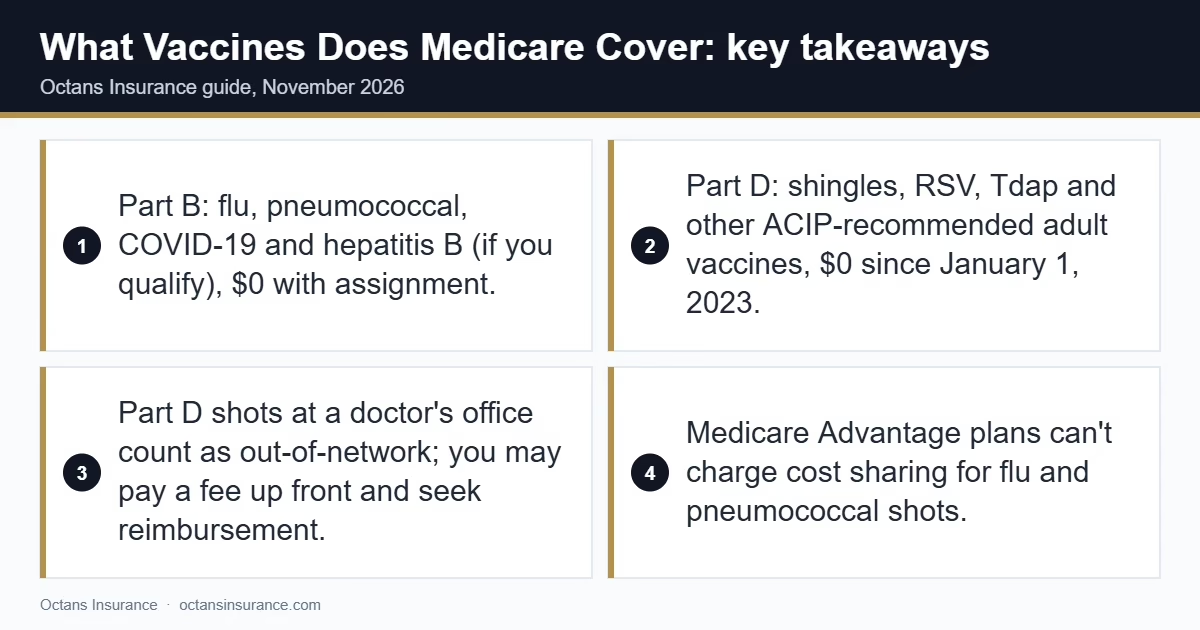
Part B covers flu, pneumococcal and COVID-19 vaccines, plus hepatitis B shots for people who meet certain conditions, at $0 when the provider accepts assignment. Part D covers other ACIP-recommended adult vaccines, such as shingles, RSV and Tdap, with no copay or deductible if you have Medicare drug coverage.
- Part B: flu, pneumococcal, COVID-19 and hepatitis B (if you qualify), $0 with assignment.
- Part D: shingles, RSV, Tdap and other ACIP-recommended adult vaccines, $0 since January 1, 2023.
- Part D shots at a doctor’s office count as out-of-network; you may pay a fee up front and seek reimbursement.
- Medicare Advantage plans can’t charge cost sharing for flu and pneumococcal shots.
Table of Contents
Make sure your family is financially protected today!
What vaccines does Medicare cover? Part B covers flu, pneumococcal and COVID-19 shots, plus hepatitis B shots for people who meet certain conditions, at no cost when your provider accepts assignment. Part D drug plans cover other recommended adult vaccines, such as shingles, RSV and Tdap, with no copay or deductible.
What vaccines does Medicare cover? The list at a glance
Medicare splits vaccines between two parts. Part B (medical insurance) covers a short list of preventive shots. Part D (drug coverage) covers most other adult vaccines. Which part pays decides where you should go and what you might owe. The table below sums up what vaccines Medicare covers, based on Medicare.gov coverage pages as of November 2026.
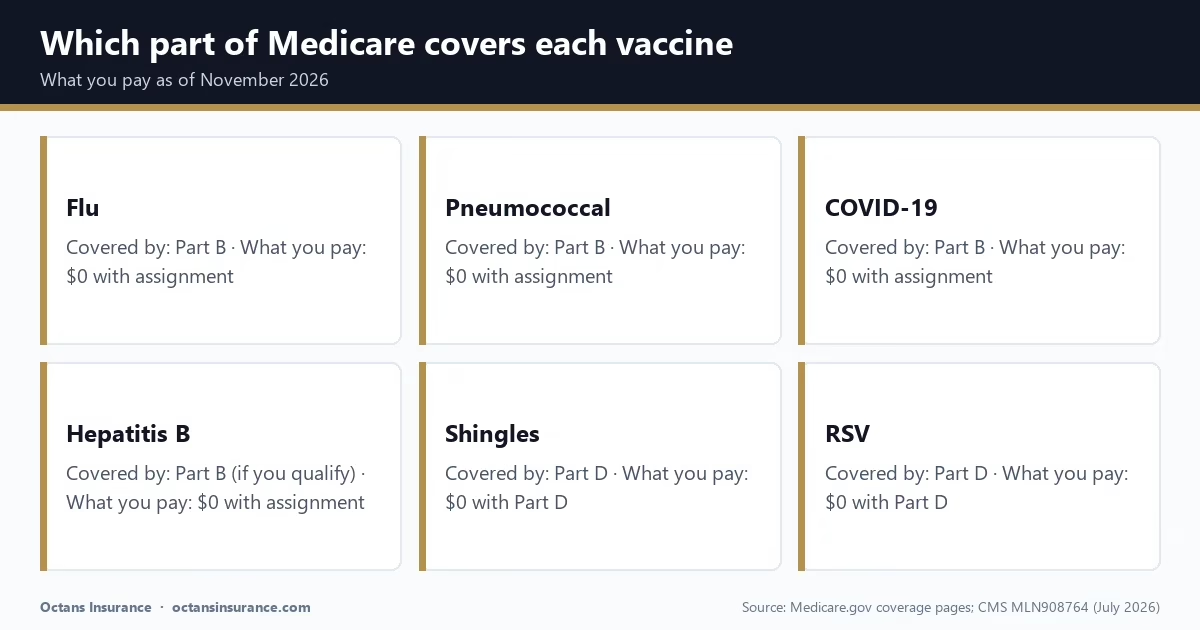
| Vaccine | Covered by | What you pay |
|---|---|---|
| Flu (seasonal) | Part B, usually one per flu season | $0 if the provider accepts assignment |
| Pneumococcal (pneumonia) | Part B | $0 if the provider accepts assignment |
| COVID-19 | Part B | $0 if the provider accepts assignment |
| Hepatitis B | Part B, if you meet the conditions | $0 if the provider accepts assignment |
| Shingles | Part D | $0 if you have Part D |
| RSV | Part D | $0 if you have Part D |
| Tdap (tetanus, diphtheria, whooping cough) | Part D | $0 if you have Part D |
| Tetanus, rabies or hepatitis A after an injury or exposure | Part B, as treatment | Ask your provider; this is treatment, not a preventive shot |
Vaccines covered by Part B
Flu. According to Medicare.gov’s flu vaccine page, Part B covers the seasonal flu vaccine, so a Medicare flu shot is usually covered once each flu season. You pay nothing if your doctor or other provider accepts assignment for giving it.
Pneumococcal. Medicare.gov says Part B covers pneumococcal vaccines, which protect against strains of the bacteria that cause pneumonia. You pay nothing if the provider accepts assignment. Talk with your doctor about which pneumococcal vaccines are right for you.
COVID-19. Medicare.gov’s COVID-19 vaccine page says Part B covers FDA-approved and FDA-authorized COVID-19 vaccines. You pay nothing if the provider accepts assignment. Bring your red, white and blue Medicare card.
Hepatitis B. This one has conditions. According to Medicare.gov’s hepatitis B page, Part B covers the shots if you have never had a complete series, you don’t know your vaccine history, or you have a condition that puts you at medium or high risk, such as diabetes or end-stage renal disease.
Shots after an injury. Part B also covers some vaccines as treatment. A CMS fact sheet for providers (July 2026) gives tetanus, rabies and hepatitis A shots after an injury or exposure as examples. A routine tetanus booster with no injury falls under Part D instead.
Vaccines covered by Part D
Part D picks up the rest, and it is the bigger half of the answer to “What vaccines does Medicare cover?” Medicare’s Your Guide to Medicare Preventive Services (May 2026) says Part D covers all adult vaccines recommended by the Advisory Committee on Immunization Practices (ACIP) that aren’t covered under Part B. Its examples include RSV, shingles, Tdap and travel vaccines like yellow fever, plus measles.
The $0 cost comes from the Inflation Reduction Act. A report from HHS’s Office of the Assistant Secretary for Planning and Evaluation says the law eliminated cost sharing and deductibles for ACIP-recommended adult vaccines starting January 1, 2023. About 10.3 million Part D enrollees got a recommended vaccine at no cost in 2023.
Does Medicare cover the shingles vaccine? Yes, through Part D. Medicare.gov says you pay nothing for the shingles vaccine if you have Part D. Part B does not cover it.
RSV vaccine and Medicare. The RSV vaccine is also a Part D vaccine. Medicare.gov’s RSV page says you pay nothing if you have Part D. It describes adults 75 and older, and adults 50 to 74 with certain conditions, as being at high risk of serious RSV illness.
Tdap. Medicare.gov’s Tdap page says the Tdap booster is covered by Part D, and you pay nothing if you have Part D.
What you pay for each vaccine
Once you know which vaccines Medicare covers under each part, the next question is cost. For most people with Medicare, the answer is $0, as long as two things line up. For Part B shots, the provider must accept assignment. For Part D shots, you must have Medicare drug coverage, and the vaccine must be ACIP-recommended. Medicare.gov’s drug coverage page adds that the Part B deductible doesn’t apply to flu, pneumococcal, COVID-19 and hepatitis B shots when the provider accepts assignment.
For example, say Ruth gets three shots this fall. Her doctor, who accepts assignment, gives her a flu shot and a COVID-19 shot under Part B. Then an in-network pharmacy gives her the RSV vaccine under her Part D plan. Her out-of-pocket cost is $0 + $0 + $0 = $0.
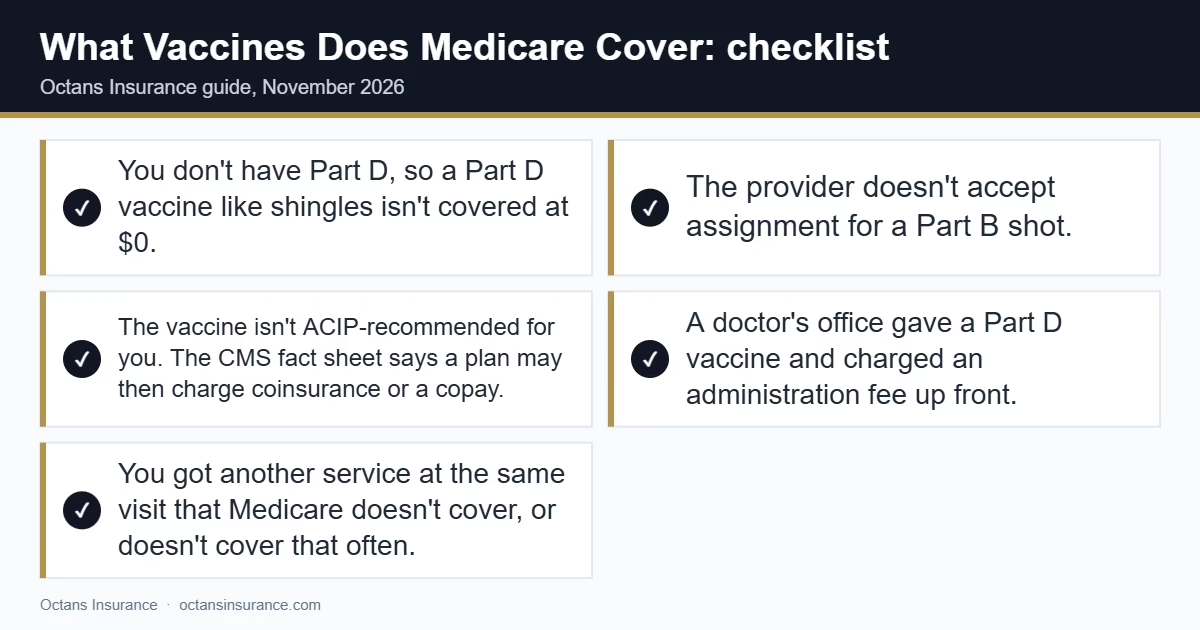
Why might you get a bill? Common reasons include:
- You don’t have Part D, so a Part D vaccine like shingles isn’t covered at $0.
- The provider doesn’t accept assignment for a Part B shot.
- The vaccine isn’t ACIP-recommended for you. The CMS fact sheet says a plan may then charge coinsurance or a copay.
- A doctor’s office gave a Part D vaccine and charged an administration fee up front.
- You got another service at the same visit that Medicare doesn’t cover, or doesn’t cover that often.
Getting vaccinated at a pharmacy vs your doctor
For Part B shots, place matters less. Medicare.gov’s flu vaccine page says you can get a flu shot at many places, including your doctor’s office and your local pharmacy. Its COVID-19 page says to bring your Medicare card so your doctor, other provider or pharmacy can bill Medicare.
Part D shots are different. The CMS fact sheet explains that Part D networks are pharmacy networks only, so CMS treats a prescriber’s office as out-of-network for Part D vaccines. If an out-of-network provider gives the shot, you may need to pay a vaccine administration fee at the time of service, then ask your Part D plan to pay you back. You still owe nothing for an ACIP-recommended vaccine itself, even out of network.
An in-network pharmacy is often simpler. The pharmacy gives the shot and bills your Part D plan in one claim. Before you go, ask the pharmacy whether it is in your plan’s network and whether it can bill your plan for that vaccine.
How Medicare Advantage plans cover vaccines
According to Medicare.gov’s How does Medicare work? page, Medicare Advantage plans must cover almost all medically necessary services that Original Medicare covers. Federal rules at 42 CFR 422.100(g) say Medicare Advantage plans may not charge cost sharing for flu and pneumococcal vaccines, and members can get a flu shot without a referral.
For Part D vaccines, the plan must include drug coverage. Medicare.gov’s RSV page says Medicare Advantage plans that include drug coverage also cover drug benefits like the RSV vaccine. Medicare’s preventive services guide notes that coverage, costs and rules can differ in a Medicare Advantage plan, so check with your plan, especially about which pharmacies are in network.
Keeping a vaccine record for 2027
A simple record helps you avoid repeat shots and billing surprises. Write down each vaccine, the date, where you got it and which card you showed.
- Bring both your Medicare card and your Part D or Medicare Advantage card to every vaccine visit.
- Check your Medicare Summary Notice or plan statement for each shot, and question charges you don’t expect.
- Ask your doctor which vaccines are due for you in 2027. Recommendations depend on age and health.
- If you change Part D or Medicare Advantage plans for 2027, check the new plan’s pharmacy network before your next shot.
- Keep the record with your medication list, so a family member can find it if needed.
To see how the parts fit together, start with our Medicare basics guide. For drug coverage, read what Medicare Part D is, and see how the Inflation Reduction Act changed Medicare. New to Medicare? The Welcome to Medicare visit is a good time to review vaccines, and our page on Medicare Part C explains how Medicare Advantage plans work.
Keep Reading: Related Guides
- Medicare basics
- What is Medicare Part D?
- How the Inflation Reduction Act changed Medicare
- The Welcome to Medicare visit
- How to Avoid IRMAA
- Extra Help Redetermination Letter
- Does Medicare Cover Pneumonia Vaccine Shots?
What Vaccines Does Medicare Cover? Part B vs Part D: Frequently Asked Questions
Does Medicare cover the shingles vaccine?
Yes, through Medicare drug coverage (Part D), not Part B. Medicare.gov says you pay nothing for the shingles vaccine if you have Part D. That also applies to a Medicare Advantage plan that includes drug coverage. Getting it at a pharmacy in your plan’s network is often simplest, because the pharmacy can bill your plan directly.
Is the flu shot free with Medicare?
Usually, yes. Part B covers the seasonal flu vaccine, usually once each flu season. According to Medicare.gov, you pay nothing if your doctor or other provider accepts assignment for giving the shot, and the Part B deductible doesn’t apply. Medicare Advantage plans may not charge cost sharing for flu shots under federal rules.
Does Medicare pay for the RSV vaccine?
Yes, through Part D. Medicare.gov says you pay nothing for the RSV vaccine if you have Part D, and Medicare Advantage plans with drug coverage also cover it. Medicare.gov describes adults 75 and older, and adults 50 to 74 with certain conditions, as being at high risk of serious RSV illness. Ask your doctor whether it is right for you.
Is the pneumonia vaccine covered by Part B?
Yes. Medicare.gov says Part B covers pneumococcal vaccines, which protect against strains of the bacteria that cause pneumonia. You pay nothing if your doctor or other provider accepts assignment for giving the vaccine. Talk with your doctor about which pneumococcal vaccines are right for you, since there is more than one type.
Why was I billed for a vaccine?
Common reasons include having no Part D coverage for a Part D vaccine, a provider who doesn’t accept assignment for a Part B shot, or a vaccine that isn’t ACIP-recommended for you. A doctor’s office may also charge a Part D vaccine administration fee up front, because CMS treats offices as out-of-network for Part D. You can ask your Part D plan to reimburse that fee. Check your statement and call your plan with questions.
We do not offer every plan available in your area. Please contact Medicare.gov or 1-800-MEDICARE to get information on all of your options.
This article is general information, not legal, tax, or medical advice. Premium examples are published samples, not quotes.
About examples and tools: Hypothetical examples, sample rates, calculators and quizzes on this site are for general educational and illustrative purposes only. They are not quotes, offers of coverage, or guarantees of eligibility, approval, price or benefits, and they are not legal, tax, financial or medical advice. The insurance company decides eligibility and price; Medicare rules are set by CMS and the Social Security Administration. Octans Insurance is not connected with or endorsed by the U.S. government or the federal Medicare program.