
Medicare Coverage
Medicare Transportation: How to Get Rides to Medical Appointments
Medicare transportation help is spread across several programs. Learn what Original Medicare and Medicare Advantage cover, how Medicaid rides work for people with both, and where PACE, paratransit and VA travel pay fit in.
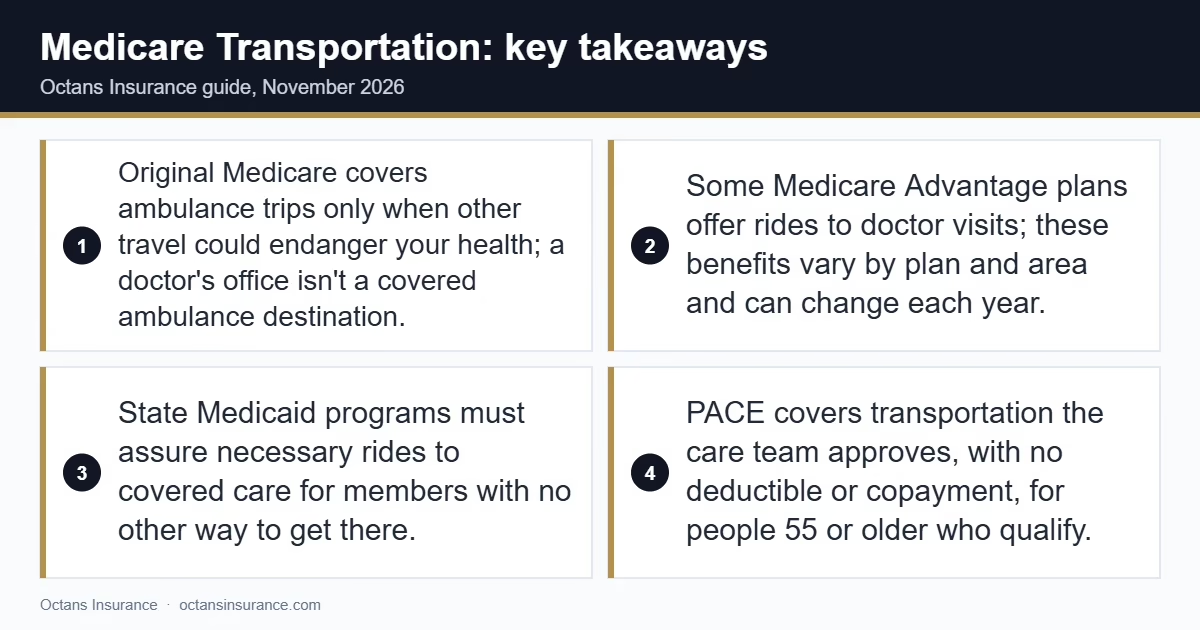
- Original Medicare covers ambulance trips only when other travel could endanger your health; a doctor’s office isn’t a covered ambulance destination.
- Some Medicare Advantage plans offer rides to doctor visits; these benefits vary by plan and area and can change each year.
- State Medicaid programs must assure necessary rides to covered care for members with no other way to get there.
- PACE covers transportation the care team approves, with no deductible or copayment, for people 55 or older who qualify.
Table of Contents
Make sure your family is financially protected today!
Medicare transportation coverage is limited. Original Medicare doesn’t pay for routine rides to doctor appointments; it covers ambulance trips only when other transportation could endanger your health. Help with everyday medical rides can come from Medicaid’s non-emergency medical transportation (NEMT) benefit, some Medicare Advantage plans, PACE, and local aging and transit services.
Does Medicare cover transportation to medical appointments?
Not under Original Medicare. Its Medicare transportation coverage is the Part B ambulance benefit, and the official Medicare ambulance booklet says Medicare covers and helps pay for ambulance services only when other transportation could endanger your health. CMS rules add that a doctor’s office is not a covered ambulance destination.
A federal Medicaid guide puts it plainly: “Medicare has a limited non-emergency ambulance transportation benefit.” The Medicare & You handbook lists “transportation to medical services” among the things people with full Medicaid may get that Medicare doesn’t cover or only partly covers.
So does Medicare cover transportation to medical appointments in any form? Apart from medically necessary ambulance trips, only through other routes. Some Medicare Advantage plans offer rides as an extra benefit, and PACE includes transportation. Outside Medicare, Medicaid, local aging programs, public transit and the VA can help. The sections below explain who qualifies for each.
Which Medicare transportation services do Medicare Advantage plans offer?
Medicare Advantage plans may cover benefits Original Medicare doesn’t. The handbook says some plans may cover “rides to doctor visits,” along with other extras. Medicare Advantage transportation benefits vary by plan and area, and the handbook warns that these benefits are generally limited, so check with the plan before you join to find out exactly what’s covered.
Plans can also offer extra benefits for people with certain chronic illnesses. You can ask a plan whether it offers them before you join, but you’ll need to wait until you join to find out if you qualify.
Ride benefits can change. Medicare Advantage costs and rules can change each year, and your plan must tell you about changes in its Annual Notice of Change, which is typically mailed before September 30. The Annual Enrollment Period for 2027 coverage runs October 15 to December 7, 2026. Our guide to changing Medicare plans explains your other options.
If you have both Medicare and Medicaid, you may also be able to join a special needs plan built for people with both. Our guide to Medicare special needs plans explains how they work.
How does Medicaid non-emergency medical transportation work?
Medicaid is separate from Medicare, but if you qualify, it can cover the everyday rides that Medicare transportation coverage leaves out. Federal rules require each state Medicaid program to “assure necessary transportation for clients to and from providers,” according to Medicaid.gov. A Medicaid.gov fact sheet calls NEMT an important service for people who don’t have the transportation they need to reach medical appointments.
It isn’t a promise to pay for every ride. CMS’s 2023 Medicaid Transportation Coverage Guide calls it “a requirement to make certain that every Medicaid beneficiary who has no other means of transportation has access to transportation needed to receive covered care.”
States must first try rides that cost nothing, like from family or friends. After that, they use the least costly mode that suits your physical and emotional condition. Rides generally go to the nearest qualified provider unless you have a medical need to see one farther away.
A ride can be by car, bus, train, plane, subway or a specialized vehicle, and states may give out public transit passes. For most overnight long-distance trips, states must cover some related costs, such as meals, lodging and an attendant when needed. How you book depends on your state, which may use a managed care plan, a broker or a county office.
If your state charges anything for a ride, it must be a nominal amount. The guide allows cost sharing for NEMT only in some cases and bars it when the state runs NEMT as an administrative activity.
Can you get Medicaid rides if you have both Medicare and Medicaid?
Yes, if you have full Medicaid benefits, so Medicaid can fill much of the Medicare transportation gap for people with both. The CMS guide says that when a full-benefit dual eligible person gets a Medicaid-coverable service that Medicare pays for first, the state must ensure necessary transportation to that service.
For Medicare-covered services that Medicaid doesn’t cover, rides are a state option. The guide’s example is a trip to the pharmacy for Part D drugs. States may choose to cover it, but they don’t have to, because Medicaid doesn’t cover Part D drugs.
“Full benefit” has a specific meaning. The guide lists people in the QMB Plus, SLMB Plus and full-benefit dual eligible groups. If you get only a Medicare Savings Program, which helps pay Medicare costs, ask your state Medicaid agency whether you qualify for rides. Use Medicaid.gov’s state finder to reach it.
Medicare transportation through PACE
The Program of All-inclusive Care for the Elderly (PACE) is a Medicare and Medicaid program offered in many states. It covers all Medicare- and Medicaid-covered care, plus other services the PACE team decides you need. The handbook lists transportation among them, along with doctor visits, home care and hospital visits.
To qualify, you must be 55 or older, live in a PACE organization’s service area, be certified by your state as needing a nursing home level of care, and be able to live safely in the community with PACE’s help when you join.
If you have Medicaid, you won’t pay a monthly premium for the PACE benefit. If you have Medicare but not Medicaid, you’ll pay a monthly premium that includes Part D drug coverage. In PACE, there’s never a deductible or copayment for any drug, service or care the PACE team approves.
Other ways to get rides to the doctor
Several programs outside Medicare offer the kinds of rides that Medicare transportation coverage leaves out. Each has its own rules.
Aging services. The Administration for Community Living lists “access to services such as transportation” among the supportive services for older adults funded under the Older Americans Act. Find your local Area Agency on Aging through the Eldercare Locator or by calling 1-800-677-1116.
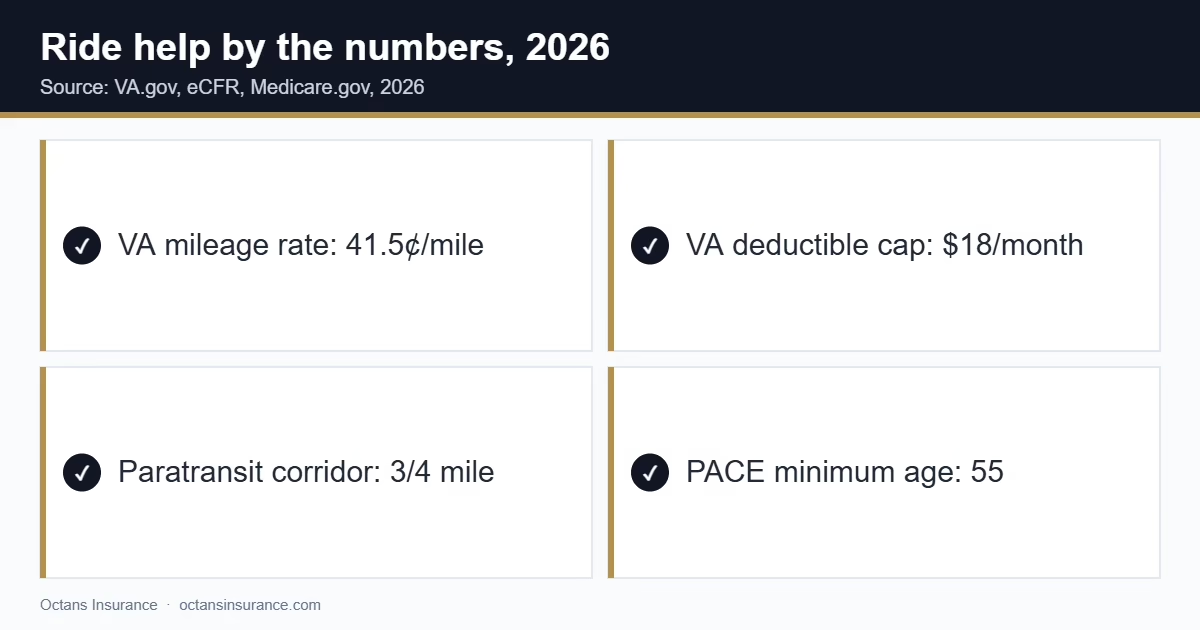
Paratransit. If a disability keeps you from using buses or trains, federal transit rules (49 CFR 37.131) apply. With some exceptions, a public transit system with fixed routes must offer comparable paratransit within three-fourths of a mile of each bus route and around each rail station. It must take ride requests made the day before and can’t limit rides by trip purpose. The fare can’t be more than twice the full fixed-route fare.
Veterans. If you travel to VA care or VA-approved community care, you may get VA travel pay of 41.5 cents a mile. You may qualify if, for example, you have a VA disability rating of 30% or higher, receive a VA pension or have income below the maximum annual VA pension rate. VA says to file within 30 days; later claims are usually denied. See our guide to Medicare for veterans.
Medicare transportation options compared
Here’s how the main Medicare transportation options and outside programs line up in 2026.
| Option | Who can use it | What it covers | What you pay |
|---|---|---|---|
| Original Medicare (Part B ambulance) | People whose condition makes other travel unsafe | Ambulance trips to covered places like hospitals; not to a doctor’s office | 20% after the $283 Part B deductible (2026) |
| Medicare Advantage ride benefit | Members of plans that offer one | Varies by plan and area | Varies by plan |
| Medicaid NEMT | Medicaid members with no other way to reach covered care | Rides to covered care by the least costly suitable mode | Nothing or a nominal amount, depending on your state |
| PACE | People 55 or older who need a nursing home level of care and live in a PACE area | Transportation the PACE team approves | No deductible or copay; a premium if you don’t have Medicaid |
| ADA paratransit | People whose disability keeps them from using fixed-route transit | Trips within three-fourths of a mile of bus routes or rail stations | Up to twice the full fixed-route fare |
| VA travel pay | Eligible veterans going to VA or VA-approved care | Round-trip mileage at 41.5 cents a mile | A $3 one-way or $6 round-trip deductible, up to $18 a month, unless waived |
Sources: Medicare.gov ambulance booklet; CMS 2026 fact sheet; CMS Medicaid Transportation Coverage Guide (SMD 23-006); Medicare & You 2027; 49 CFR 37.131; VA.gov. Checked November 6, 2026.
Hypothetical example: Glenn, a veteran with Original Medicare, has a 30% VA disability rating and income above the VA waiver limits, so the travel deductible applies. He drives 25 miles each way to a VA clinic. One 50-mile round trip pays 50 x $0.415 = $20.75, minus the $6 round-trip deductible, or $14.75. For 4 round trips in a month, his mileage totals 200 x $0.415 = $83.00. His deductibles would add up to $24, but the $18 monthly cap applies, so VA pays him $65.00.
How to find Medicare transportation help near you
- If you have Medicare Advantage, read your plan’s benefit documents or call the plan to ask whether it covers rides and how to book them.
- If you have Medicaid or think you might qualify, contact your state Medicaid agency and ask how to schedule NEMT rides.
- If you’re 55 or older and need a lot of care, check Medicare.gov/pace to see whether a PACE organization serves your area.
- Call the Eldercare Locator at 1-800-677-1116 to reach your Area Agency on Aging and ask about local ride programs.
- Ask your local transit agency how to apply for ADA paratransit if a disability keeps you from riding the bus or train.
- If you’re a veteran, ask your VA facility about travel pay and file each claim within 30 days.
Questions to ask any ride program or plan:
- How many rides do I get each year, and does a round trip count as one ride or two?
- How far ahead do I have to book, and what happens if my appointment runs late?
- Which destinations count, such as doctors, pharmacies, dialysis or therapy?
- Can a caregiver ride with me, and are wheelchair-accessible vehicles available?
- Is there any cost to me for each ride?
Medicare transportation: frequently asked questions
Does Medicare pay for taxi or rideshare trips to the doctor?
Original Medicare doesn’t. Some Medicare Advantage plans offer rides to doctor visits, and those benefits vary by plan and area. If you have Medicaid and no other way to reach covered care, your state must make sure you have necessary transportation, using the least costly mode that suits your condition. Local aging programs may also offer rides.
Does Medicare Part A cover transportation?
No, not for everyday rides. Medicare transportation coverage under Original Medicare is the Part B ambulance benefit, which pays only when other transportation could endanger your health. Medicare’s handbook lists rides to doctor visits as an extra some Medicare Advantage plans offer, not a Part A or Part B benefit. Medicaid NEMT, PACE and community programs can also help.
Does Medicare cover transportation to dialysis?
Original Medicare covers it only by ambulance, and only when other transportation could endanger your health and your doctor writes an order. If you can travel safely by car or van, Medicare won’t pay for the ride. If you also have full Medicaid, ask your state about NEMT. Some Medicare Advantage plans offer rides, which vary by plan and area.
Can I deduct the cost of rides to medical care?
Possibly. IRS Publication 502 lets you include amounts paid for transportation “primarily for and essential to medical care,” such as bus, taxi, train or plane fares. For July 1 through December 31, 2026, the IRS medical mileage rate is 23.5 cents a mile; it was 20.5 cents for January through June. Only the part of your medical costs above 7.5% of your adjusted gross income is deductible, and only if you itemize. Ask a tax professional about your situation.
Can Medicare Advantage transportation benefits change next year?
Yes. Medicare Advantage costs and rules can change each year. Your plan must tell you about changes through its Annual Notice of Change, typically mailed before September 30. If the ride benefit shrinks or ends, you can switch plans during the Annual Enrollment Period, which runs October 15 to December 7 each year.
Who do I call to book a Medicaid ride?
It depends on your state. States run NEMT through managed care plans, statewide or regional brokers, or local government offices such as counties. Your Medicaid plan’s member services line or your state Medicaid agency can tell you which one serves you. Medicaid.gov has a state-by-state finder with contact information for each agency.

How a licensed Octans agent can help
A licensed Octans agent can compare the Medicare transportation services in Medicare Advantage plans available where you live, including how many trips each plan covers and how to book them. If you have both Medicare and Medicaid, an agent can explain whether a plan for dual eligible members is available in your area.
Octans is an independent agency and isn’t connected with Medicare, Medicaid or any government agency. Agents don’t arrange Medicaid rides; your state Medicaid agency does. For free, unbiased counseling, contact your State Health Insurance Assistance Program (SHIP), or call 1-800-MEDICARE (1-800-633-4227; TTY 1-877-486-2048). To talk with an Octans agent, call (617) 935-9220.
Keep Reading: Related Guides
- Medicare Advantage (Part C) explained
- Medicare special needs plans
- Medicare for veterans
- Does Medicare Cover Ambulance Rides? What You Pay in 2026
- Medicare vs Medicaid
- Medicare and Home Health Care
- Medicare and ESRD
We do not offer every plan available in your area. Please contact Medicare.gov or 1-800-MEDICARE to get information on all of your options.
This article is for general information and is not tax, legal, or medical advice.
About examples and tools: Hypothetical examples, sample rates, calculators and quizzes on this site are for general educational and illustrative purposes only. They are not quotes, offers of coverage, or guarantees of eligibility, approval, price or benefits, and they are not legal, tax, financial or medical advice. The insurance company decides eligibility and price; Medicare rules are set by CMS and the Social Security Administration. Octans Insurance is not connected with or endorsed by the U.S. government or the federal Medicare program.
Compare plans with ride benefits near you
Start with a free, no-obligation quote review with a licensed Octans agent.
(617) 935-9220 | life@octansinsurance.com