
Part D Costs
Medicare Donut Hole: What Replaced the Coverage Gap in 2026
The Medicare donut hole ended in 2025, and this guide explains the three Part D stages that replaced it, what counts toward the 2026 cap, and how the numbers change in 2027.
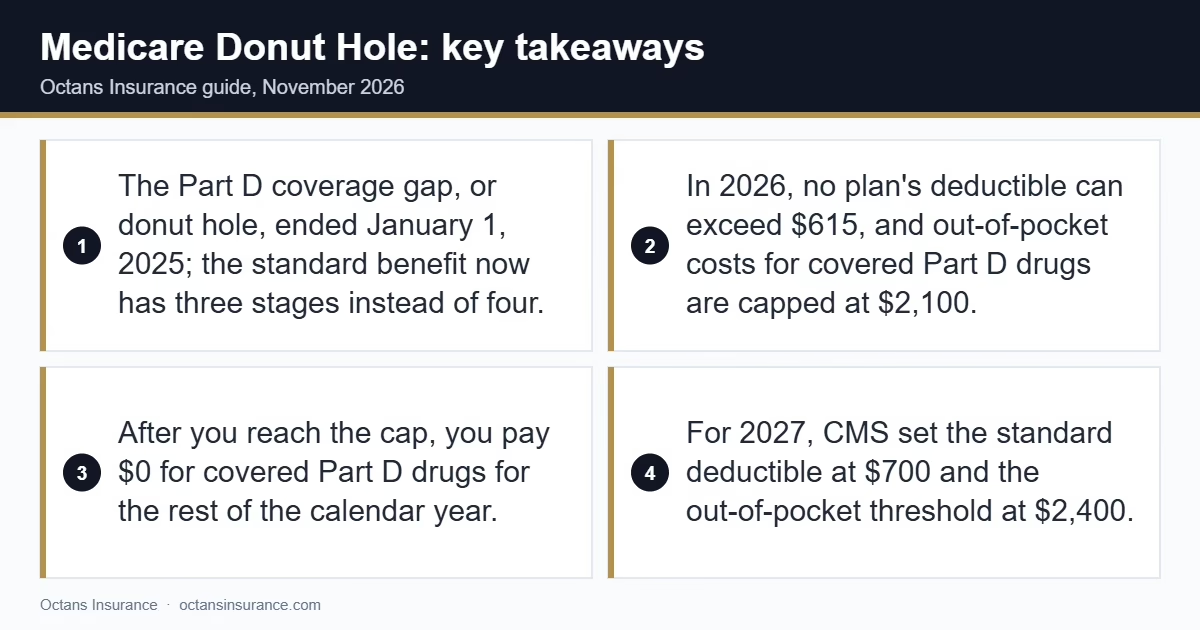
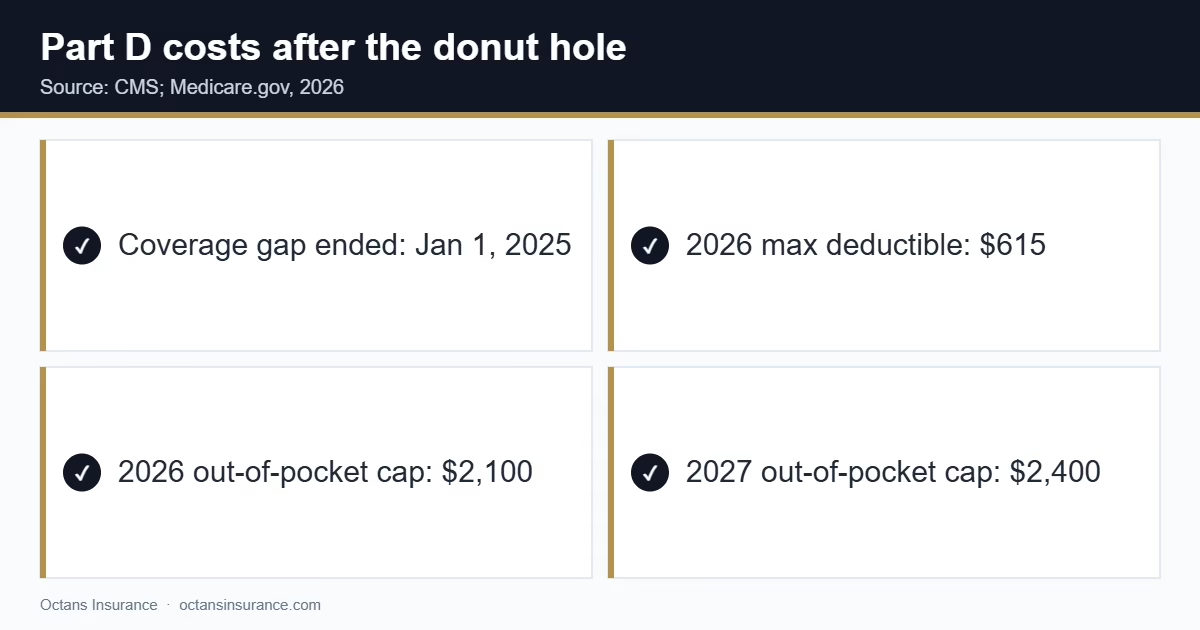
- The Part D coverage gap, or donut hole, ended January 1, 2025; the standard benefit now has three stages instead of four.
- In 2026, no plan’s deductible can exceed $615, and out-of-pocket costs for covered Part D drugs are capped at $2,100.
- After you reach the cap, you pay $0 for covered Part D drugs for the rest of the calendar year.
- For 2027, CMS set the standard deductible at $700 and the out-of-pocket threshold at $2,400.
Table of Contents
Make sure your family is financially protected today!
The Medicare donut hole is gone. Since January 1, 2025, Part D drug coverage has had three stages instead of four, with no coverage gap. In 2026, you pay no more than a $615 deductible, then your share of costs until your out-of-pocket spending on covered drugs reaches $2,100. After that, you pay $0 for covered Part D drugs for the rest of the year.
Is there still a Medicare donut hole in 2026?
No. The Medicare donut hole closed when the Inflation Reduction Act of 2022 rebuilt the standard Part D benefit. CMS’s final 2025 Part D redesign instructions say the new benefit has three phases instead of four, because the coverage gap phase was eliminated. The changes took effect January 1, 2025, and apply to all Part D plans.
Here is how the three stages work in 2026, in Medicare.gov’s terms:
- Deductible stage. You pay the full cost of covered drugs until you meet your plan’s deductible. No Medicare drug plan may have a deductible above $615 in 2026, and some plans have none.
- Initial coverage stage. In the standard design, you pay 25% coinsurance until your out-of-pocket spending on covered Part D drugs reaches $2,100. Depending on the plan, you may pay a copay (a fixed amount) or coinsurance (a percentage), and the amount depends on the drug’s tier.
- Catastrophic coverage stage. You don’t pay out of pocket for covered Part D drugs for the rest of the calendar year.
Medicare drug plans and Medicare Advantage plans with drug coverage generally use these same three stages. For a full overview of drug plans, see our Medicare Part D guide.
What was the Medicare donut hole?
The Medicare Part D donut hole was the nickname for the coverage gap, a stage of the standard drug benefit that lasted through 2024. CMS describes the 2024 benefit in four phases, and its 2025 Rate Announcement lists the 2024 dollar amounts:
- Deductible: you paid 100% of your covered drug costs until you met the $545 deductible.
- Initial coverage: you paid 25% until total drug spending, yours and your plan’s, reached the $5,030 initial coverage limit.
- Coverage gap: you kept paying 25% until you reached the $8,000 yearly out-of-pocket threshold.
- Catastrophic: you paid $0 in cost sharing for Part D drugs.
So the Medicare coverage gap sat between two limits. It started once total drug spending passed the initial coverage limit, and it ended only when your out-of-pocket spending, as Medicare counted it, reached the threshold. For 2025, the law cut the threshold to $2,000 and removed the gap phase.
Medicare donut hole then and now: 2024 to 2027
This table compares the standard Part D benefit in the last year of the Medicare donut hole with the years since. Plans can set lower deductibles, so check your own plan’s numbers.
| Year | Standard deductible | Coverage gap? | Out-of-pocket threshold | You pay after the threshold |
|---|---|---|---|---|
| 2024 | $545 | Yes, after $5,030 in total drug spending; you paid 25% | $8,000 | $0 |
| 2025 | $590 | No | $2,000 | $0 |
| 2026 | $615 | No | $2,100 | $0 |
| 2027 | $700 | No | $2,400 | $0 |
Sources: CMS CY 2025 Rate Announcement, Tables V-2 and V-6 (April 1, 2024); CMS Final CY 2025 Part D Redesign Program Instructions (April 1, 2024); CMS CY 2026 Part D redesign fact sheet (April 7, 2025); CMS CY 2027 Rate Announcement, Tables V-2 and V-6 (April 6, 2026). Standard-benefit amounts, as of November 2026.
The amounts rise each year. CMS’s 2027 Rate Announcement explains that the deductible and threshold grow with yearly Part D drug spending, with the deductible rounded to the nearest $5 and the threshold to the nearest $50. A CMS fact sheet says the 2026 threshold of $2,100 is the original $2,000 cap adjusted this way.
How the out-of-pocket cap works in 2026
The cap replaced the Medicare coverage gap as the number that matters most. It limits what you spend on drugs your plan covers, and Medicare.gov says the $2,100 limit applies to everyone with Medicare drug coverage. Here’s what counts, based on Medicare.gov’s drug cost page:
- Counts: what you pay for covered Part D drugs, from the deductible through your copays or coinsurance.
- Counts: certain payments made on your behalf, like those through Extra Help. State Pharmaceutical Assistance Program payments may count, too.
- Doesn’t count: drugs your plan doesn’t cover, and drugs you buy with a discount card instead of your Medicare plan. Medicare.gov says discount-card purchases, including TrumpRx, don’t count toward your deductible or out-of-pocket maximum.
- Separate: your monthly premium. Medicare.gov describes it as an amount you pay for coverage each month, whether you get covered drugs or not.
Insulin has its own limit. Under Medicare’s insulin coverage rules, a one-month supply of each covered insulin product costs no more than $35, and you don’t pay a deductible for it. A three-month supply generally costs no more than $105.
To see where you stand, read the Explanation of Benefits your plan sends the month after the pharmacy bills it. It shows your coverage stage and what counts toward your out-of-pocket costs.
What does a year of drug costs look like in 2026?
Hypothetical example: Vernon takes one brand-name drug that costs $800 a month in total. His plan uses the standard 2026 design: the full $615 deductible, then 25% coinsurance until he reaches the $2,100 cap. His monthly premium is extra and isn’t part of this math.
- January: he pays the $615 deductible plus 25% of the remaining $185 ($46.25), for a total of $661.25.
- February to August: he pays 25% of $800, or $200 a month. Seven months add $1,400, so his running total reaches $2,061.25.
- September: only $38.75 is left before the cap ($2,100 − $2,061.25), so that’s all he pays.
- October to December: he pays $0 for covered drugs.
Vernon’s total for 2026 is $2,100, even though his drug’s full cost for the year is $9,600 (12 × $800). Under the 2024 rules, his total drug spending would have passed the $5,030 initial coverage limit in July (7 × $800 = $5,600), putting him in the Medicare coverage gap.
If his plan used the standard design again in 2027, January would cost the $700 deductible plus 25% of $100, or $725. He would reach the higher $2,400 cap in October and pay $300 more for the year than in 2026.
Why do people still search for the Medicare donut hole?
The coverage gap was part of Part D through 2024, so many people still look up the Medicare donut hole by name. Older articles, mailers and family advice may still use it. Even Medicare.gov’s old web address for costs in the coverage gap now opens its general page on drug costs.
Your costs can still feel uneven during the year, for reasons that have nothing to do with a gap:
- The deductible. Early in the year, you may pay full price until you meet it, up to $615 in 2026.
- Coinsurance on a costly drug. A percentage of a high price can still mean a large bill until you reach the cap.
- Drugs your plan doesn’t cover. They don’t count toward the cap at all.
- A new year. The deductible and the cap are yearly amounts, so they start over with each calendar year.
If an ad or caller offers to get you “out of the donut hole,” treat it as a sign the pitch is out of date. Check any claim about the Medicare Part D donut hole with your plan or with 1-800-MEDICARE.

How to plan your Part D costs for 2027
The Open Enrollment Period for 2027 coverage runs from October 15 to December 7, 2026. With a cap instead of a Medicare donut hole, you can work out a plan’s worst case in advance:
- Read your plan’s Annual Notice of Change. It lists changes in coverage and costs that start in January. Our Annual Notice of Change checklist walks you through it.
- List every drug you take, with the dose, how often you fill it and the pharmacy you use.
- Compare plans in Medicare Plan Finder at Medicare.gov/plan-compare. Our Medicare Plan Finder guide shows how.
- Add up a full year for each plan: 12 months of premiums, plus your drug costs up to the 2027 cap of $2,400.
- If most of your drug costs will come early in the year, ask the plan about the Medicare Prescription Payment Plan. It spreads your share into monthly bills, but it doesn’t save you money.
- Check whether you qualify for Extra Help, which helps people with limited income and resources pay drug costs.
- Make your choice by December 7, 2026. Once the new year starts, check each Explanation of Benefits.
Questions to ask before you pick a drug plan
Now that the Medicare donut hole is gone, the plan’s drug list, tiers and premium drive your costs. Bring this checklist to any plan comparison:
- Is each of my drugs on the plan’s drug list, and what tier is each one on?
- Does the plan have a deductible in 2027, and are any of my drugs’ tiers covered before it?
- Will I pay a copay or coinsurance for each drug?
- Will I pay less at a preferred pharmacy or by mail order?
- What is the monthly premium, and will my income add an extra amount (IRMAA)?
- How will I know when I’ve reached the $2,400 cap?
Premiums, deductibles and drug lists vary by plan and area, and plans can change them each year. For the law’s other drug changes, such as negotiated drug prices, see our Inflation Reduction Act and Medicare guide.
Medicare donut hole frequently asked questions
Did the Medicare Part D donut hole close?
Yes. The Medicare coverage gap phase ended on January 1, 2025, when the Inflation Reduction Act’s Part D redesign took effect. Since then, the standard benefit has had three stages: the deductible, initial coverage and catastrophic coverage. In 2026, once your out-of-pocket spending on covered drugs reaches $2,100, you pay $0 for covered Part D drugs for the rest of the year.
Will there be a Medicare donut hole in 2027?
No. CMS’s 2027 Rate Announcement keeps the three-stage benefit, with a standard deductible of $700 and an out-of-pocket threshold of $2,400. The Medicare & You 2027 handbook says that once you reach the limit, you’ll pay $0 for your covered Part D drugs for the rest of the year. Some plans have lower deductibles.
Does the cap apply to Medicare Advantage plans with drug coverage?
Yes. Medicare.gov says Medicare drug plans and Medicare Advantage plans with drug coverage generally have the same three stages, and the 2026 limit of $2,100 applies to everyone with Medicare drug coverage. Copays, drug lists and pharmacy networks still vary by plan and area, so the path to the cap can look different from one plan to the next.
Does Extra Help count toward the $2,100 cap?
Yes. Medicare.gov says certain payments made on your behalf, like those through the Extra Help program, count toward your out-of-pocket spending. Extra Help also lowers what you pay, and the Medicare handbook notes that if you get it, you won’t have some Part D costs. If you have limited income and resources, check whether you qualify before you choose a plan.
Do premiums count toward the cap?
No. The cap limits your out-of-pocket costs for covered drugs, such as your deductible, copays and coinsurance. Your premium is separate: Medicare.gov describes it as a monthly amount you pay for coverage, whether you get covered drugs or not. When you compare plans, add 12 months of premiums to your expected drug costs, up to the cap.
Is insulin still capped at $35?
Yes. A one-month supply of each insulin product covered by Part B or Part D costs no more than $35, and you don’t pay a deductible for it. A three-month supply generally costs no more than $105. Medicare.gov says that under Part D, the $35 limit applies to everyone who takes insulin, even if you get Extra Help.

How a licensed Octans agent can help
Octans Insurance is an independent agency, not Medicare or a government office. If you ask, a licensed agent can enter your drugs and pharmacy, compare Part D plans and Medicare Advantage plans with drug coverage in your area, and show each plan’s yearly premiums, deductible and estimated drug costs up to the 2027 cap.
An agent can’t promise what you’ll pay. Your plan’s Evidence of Coverage and drug list set your actual costs. Call (617) 935-9220 with questions.
For unbiased counseling at no charge, contact your State Health Insurance Assistance Program (SHIP) at shiphelp.org, or call 1-800-MEDICARE (1-800-633-4227; TTY 1-877-486-2048).
Keep Reading: Related Guides
- Medicare Part D explained
- Inflation Reduction Act and Medicare
- Medicare Extra Help
- Medicare Prescription Payment Plan
We do not offer every plan available in your area. Please contact Medicare.gov or 1-800-MEDICARE to get information on all of your options.
This article is for general information and is not tax, legal, or medical advice.
About examples and tools: Hypothetical examples, sample rates, calculators and quizzes on this site are for general educational and illustrative purposes only. They are not quotes, offers of coverage, or guarantees of eligibility, approval, price or benefits, and they are not legal, tax, financial or medical advice. The insurance company decides eligibility and price; Medicare rules are set by CMS and the Social Security Administration. Octans Insurance is not connected with or endorsed by the U.S. government or the federal Medicare program.
Compare 2027 drug plans with a licensed agent
Start with a free, no-obligation quote review with a licensed Octans agent.
(617) 935-9220 | life@octansinsurance.com