
Life Insurance Basics
Can You Get Life Insurance on Someone Else? Interest and Consent
Can you get life insurance on someone else? Learn who has an insurable interest, why an adult must consent in writing, and how owner, insured and beneficiary roles fit together.
- Florida law requires an insurable interest when the policy is made; it need not exist after coverage starts.
- Massachusetts requires a written application signed or assented to in writing by the person to be insured.
- In Florida, the insured’s signature on the application counts as written consent.
- Both states let a parent or custodian insure a child younger than 15 without the child’s consent.
Table of Contents
Make sure your family is financially protected today!
Can you get life insurance on someone else? Yes, if two things are true. You need an insurable interest in that person, such as being a close family member or having a real financial stake in their life. And an adult generally must agree: state laws such as Florida’s and Massachusetts’ require the insured adult to sign or consent in writing, with narrow exceptions. Parents can insure young children.
This guide explains who has an insurable interest, why consent is required, how the owner, insured and beneficiary roles work, and what the application asks of the person being insured. Rules vary by state, so treat this as general information, not legal advice.
Can you get life insurance on someone else?
Yes. Spouses insure each other. Parents insure children. Business partners insure each other. But state law sets two tests that a policy on another adult usually must pass.
- Insurable interest. Under Florida Statutes § 627.404, no one may buy a policy on another person unless the benefits are payable to the insured, their personal representatives, or someone with an insurable interest in the insured at the time the contract was made.
- Consent. The same Florida law says a policy on a person can’t be made unless that person, having legal capacity, applies for it or consents in writing to it and its terms.
Florida’s law lets anyone of legal capacity insure their own life for the benefit of any person. The extra tests apply when the person paying for the policy is not the person being insured.
So can you buy life insurance for someone else? Yes, if you pass both tests. You can’t buy it secretly on a stranger or a coworker.

Can you get life insurance on someone else if you’re not related?
Sometimes. It turns on insurable interest, which means you’d suffer a real loss, emotional or financial, if the person died. Each state defines it in its own law. Florida’s statute is a clear example because it lists the interests one by one.
| Who wants the policy | Insurable interest under Florida law? | Extra condition |
|---|---|---|
| You, on your own life | Yes | You can name any beneficiary |
| Someone closely related to you by blood or by law | Yes | You have “a substantial interest engendered by love and affection” in them |
| Someone who gains financially from the person staying alive | Yes | A substantial financial advantage from their life and loss from their death |
| Party to a contract to buy or sell a business interest | Yes | Only for the purpose of that contract |
| Business, on owners, officers or key employees | Yes | Written consent from key employees or persons before purchase |
| Qualifying 501(c)(3) charity | Yes | The person consents in writing |
Source: Florida Statutes § 627.404(2)(b), 2026 Florida Statutes, as of November 2026. Other states use their own definitions.
Timing matters. Florida’s law looks for an insurable interest at the time the contract is made, and it says the interest “need not exist after the inception date of coverage.” The statute doesn’t mention divorce. If you’re divorcing or divorced and own a policy on your former spouse, ask an attorney or your state insurance department how your state’s rules apply. Our life insurance and divorce guide covers the insurance questions to raise.
Some groups are limited by law. Texas Insurance Code § 1103.053 says a business engaged in burying the dead does not have an insurable interest in a person’s life unless it’s established under other law.
Can you get life insurance on someone without their consent?
For an adult, generally no. Here’s what three Octans states say:
- Massachusetts. Under Mass. General Laws ch. 175, § 123, a life company may not issue a policy except on a written application signed or assented to in writing by the person to be insured. The same section has exceptions for minors under 15 and for a single policy covering two or more family members, which either parent, a step-parent, or a husband or wife may sign.
- Florida. Section 627.404 requires the insured to apply for or consent in writing to the contract. The insured’s signature on the application counts as written consent.
- Texas. Texas Insurance Code § 1103.056 lets an adult, in a single written document, consent to a third party buying a policy on their life and to who will own it and receive the benefit.
So can you get life insurance on someone without their consent? Only in narrow cases. The main exception is young children; Massachusetts also allows a single policy on several family members signed by a parent, step-parent or spouse. Massachusetts lets a parent, guardian or other person with legal custody sign for a minor under 15. Florida lets a person with an insurable interest in a minor younger than 15, or a person the minor depends on for support, buy a policy on the minor. See our life insurance for children guide for how that works.
Florida’s consent rule also doesn’t apply to group life insurance, such as coverage through work. And if you’re trying to insure an aging parent, consent and capacity raise their own questions; our guide to life insurance on your parents covers that case.

Owner, insured and beneficiary: who’s who?
When you buy life insurance for someone else, three roles can belong to different people. Knowing them clears up most confusion.
| Role | What it means | Example |
|---|---|---|
| Owner | Controls the policy, pays premiums and can change beneficiaries | You |
| Insured | The person whose death triggers the payout; must consent if an adult | Your spouse |
| Beneficiary | Receives the death benefit | You, or your children |
Sources: Texas Insurance Code ch. 1103; NAIC Life Insurance Buyer’s Guide (2026). As of November 2026.
Texas law lets an adult applying on their own life name any person or entity as a beneficiary, an owner, or both. The NAIC Life Insurance Buyer’s Guide notes that as the policy owner, you can change beneficiaries at no cost. It also says you’ll need the Social Security or tax ID number for all beneficiaries.
Ownership is the key choice. If your spouse owns the policy on their own life, they control it. If you own it, you control it, even though they’re the insured. Our life insurance beneficiary guide explains how to set up beneficiaries well.
Do you need permission to get life insurance on someone?
Do you need permission to get life insurance on someone? For an adult, generally yes. In practice that permission shows up in three places:
- Signatures. Florida treats the insured’s signature on the application as written consent. Massachusetts requires the application to be signed or assented to in writing by the insured.
- Health questions. The NAIC says that, depending on the policy, the insurer may require a doctor visit, health questions or a home or office visit from a medical professional. Those questions are about the insured, so they have to take part.
- Exams and records. Policygenius, an online insurance broker, says requirements such as a medical exam or medical records vary by carrier, product, age and benefit amount.
Honesty applies to both of you. The NAIC warns that if an insurer finds false statements on an application after it issues the policy, it could reduce or cancel coverage. The Texas Department of Insurance (TDI) says policies have a two-year contestable period, and if the company learns of wrong information, it can deny payment.
Florida’s law also protects the insured. If someone without an insurable interest gets a policy and collects benefits, the insured or their personal representative may sue to recover those benefits from whoever received them.
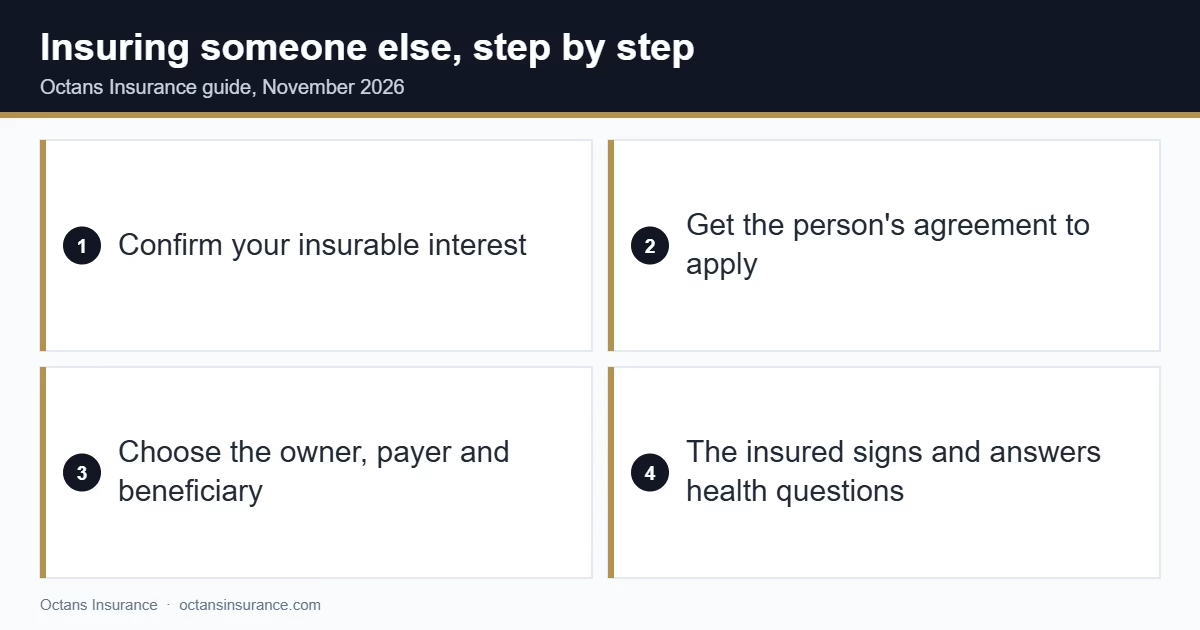
How to buy life insurance for someone else
- Confirm your insurable interest. Name the relationship or financial stake. Family ties and business contracts are the common ones.
- Talk to the person first. They’ll need to sign and answer health questions, so the plan has to be shared.
- Decide the roles. Choose who owns the policy, who pays and who is the beneficiary.
- Pick the policy type and amount. Match the coverage to the loss you’re protecting against, such as lost income or a buyout price.
- Apply together. The insured signs the application and completes any exam or interview. See our life insurance medical exam guide.
- Review the policy on arrival. The NAIC says you can usually return a new policy for a full refund within about 10 days.
Insuring a business partner: a worked example
Hypothetical example: Ana and Ben each own 50% of a small company in Florida. They sign a buy-sell contract. It says that if one dies, the other buys the dead partner’s half from their family. They agree the company is worth $600,000.
- Each half is worth $600,000 × 50% = $300,000.
- Ana buys and owns a $300,000 policy on Ben’s life, and names herself as beneficiary.
- Ben buys and owns a $300,000 policy on Ana’s life, and names himself as beneficiary.
- Total coverage across both policies: $300,000 + $300,000 = $600,000.
Florida’s law gives a party to a contract to buy or sell a business interest an insurable interest in the other party, for that contract only. Each partner still signs as the insured on the policy covering them. If Ben dies, Ana receives $300,000 and uses it to buy his half from his family. The values are hypothetical; an attorney should draft the contract. Our buy-sell agreement life insurance guide goes further.
Checklist before you apply
- Can you state your insurable interest in one sentence?
- Has the person agreed, and will they sign the application?
- Is the person an adult with the capacity to consent?
- Who will own the policy, and who will pay?
- Do you have the Social Security or tax ID number for each beneficiary?
- Will the insured answer health questions honestly and take an exam if asked?
- Does the coverage amount match the actual loss?
- For grandparents insuring a grandchild, have you read our life insurance for grandchildren guide?
Can you get life insurance on someone else? Frequently asked questions
Can you get life insurance on someone without them knowing?
Generally not on an adult. Florida requires the insured to apply for or consent in writing to the policy, and Massachusetts requires the insured to sign or assent in writing to the application. Each law has narrow exceptions, such as young children and, in Massachusetts, a single family policy. The insurer also usually asks the insured health questions and may require an exam.
Can you buy life insurance for someone else and be the beneficiary?
Yes, if you have an insurable interest and the person consents. Florida’s law requires that benefits on another person’s life be payable to the insured, their personal representatives, or someone with an insurable interest at the time the contract was made. A spouse, close relative or business partner commonly owns the policy and is also the beneficiary.
Can I take out life insurance on my boyfriend or girlfriend?
It depends on your state’s law, the facts and the insurer. Florida’s statute lists the interests that count, including close relatives by blood or by law and people who expect a substantial financial advantage from the other person’s continued life. It doesn’t mention unmarried partners. For your situation, ask an attorney or your state insurance department. Either way, your partner would need to consent in writing.
Does insurable interest have to last for the life of the policy?
Not in Florida. Section 627.404 looks for an insurable interest at the time the contract is made and says it need not exist after coverage starts. Other states may word this differently. The Florida statute doesn’t address divorce or the end of a business deal, so for those situations ask an attorney or your state insurance department.
Can a parent buy life insurance on an adult child?
Florida’s statute gives an insurable interest to close relatives by blood or by law in whom you have a substantial interest engendered by love and affection. Even so, an adult child generally must consent. Florida’s and Massachusetts’ rules letting a parent apply without the child’s consent cover minors under 15. Massachusetts also has a separate rule for a single policy covering several family members. Otherwise, the adult child signs, even if the parent owns and pays.
What happens if someone buys a policy without an insurable interest?
The policy can be challenged. In Florida, if someone without an insurable interest collects benefits, the insured or their personal representative may sue to recover those benefits. Florida also lets insurers rely on what applicants say about their insurable interest. Misstating facts on an application can also lead an insurer to reduce or cancel coverage, the NAIC says.

How a licensed Octans agent can help
If you’re unsure whether you can buy life insurance for someone else in your situation, a licensed Octans agent can walk you and the person you want to insure through the roles, the consent forms and the health questions before you apply. Octans works with more than 120 carriers, so you can compare how insurers handle a policy owned by someone other than the insured.
An agent can’t give legal advice. For a buy-sell contract, a trust or a divorce, talk with an attorney. Approval and price depend on each insurer’s underwriting.
Call (617) 935-9220 to talk it through. Octans serves 19 states.
Keep Reading: Related Guides
Important: Octans Insurance agents are licensed in the states in which they operate. Coverage availability and rates may vary by state. Premium examples, when provided, are illustrative samples from published sources, not quotes. Final rates are determined by the insurance carrier based on underwriting and applicable policy criteria. Policy terms, exclusions, limitations, riders, and availability vary by carrier and state.
About examples and tools: Hypothetical examples, sample rates, calculators and quizzes on this site are for general educational and illustrative purposes only. They are not quotes, offers of coverage, or guarantees of eligibility, approval, price or benefits, and they are not legal, tax, financial or medical advice. The insurance company decides eligibility and price; Medicare rules are set by CMS and the Social Security Administration.
Insuring someone else? Talk it through first
Start with a free, no-obligation quote review with a licensed Octans agent.
(617) 935-9220 | life@octansinsurance.com