
Medicare Coverage
Does Medicare Cover Kidney Transplant Surgery and Drugs?
Does Medicare cover kidney transplant surgery, your donor and the drugs you take afterward? Here is what Parts A and B pay, what you owe in 2026, and what changes after 36 months.
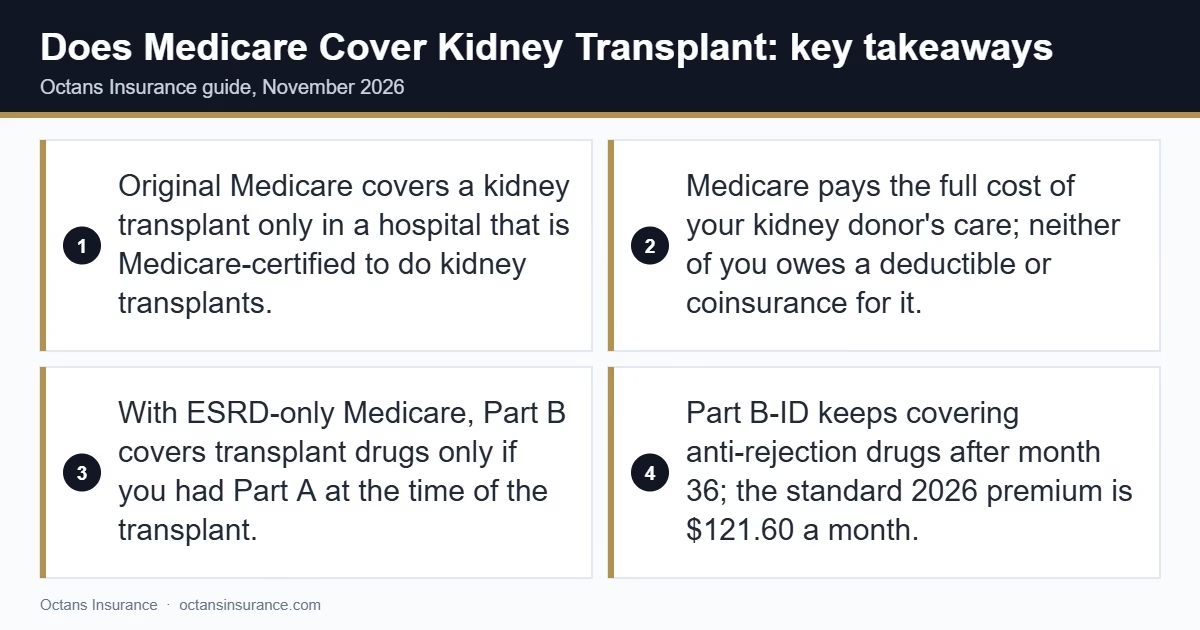
- Original Medicare covers a kidney transplant only in a hospital that is Medicare-certified to do kidney transplants.
- Medicare pays the full cost of your kidney donor’s care; neither of you owes a deductible or coinsurance for it.
- With ESRD-only Medicare, Part B covers transplant drugs only if you had Part A at the time of the transplant.
- Part B-ID keeps covering anti-rejection drugs after month 36; the standard 2026 premium is $121.60 a month.
Table of Contents
Make sure your family is financially protected today!
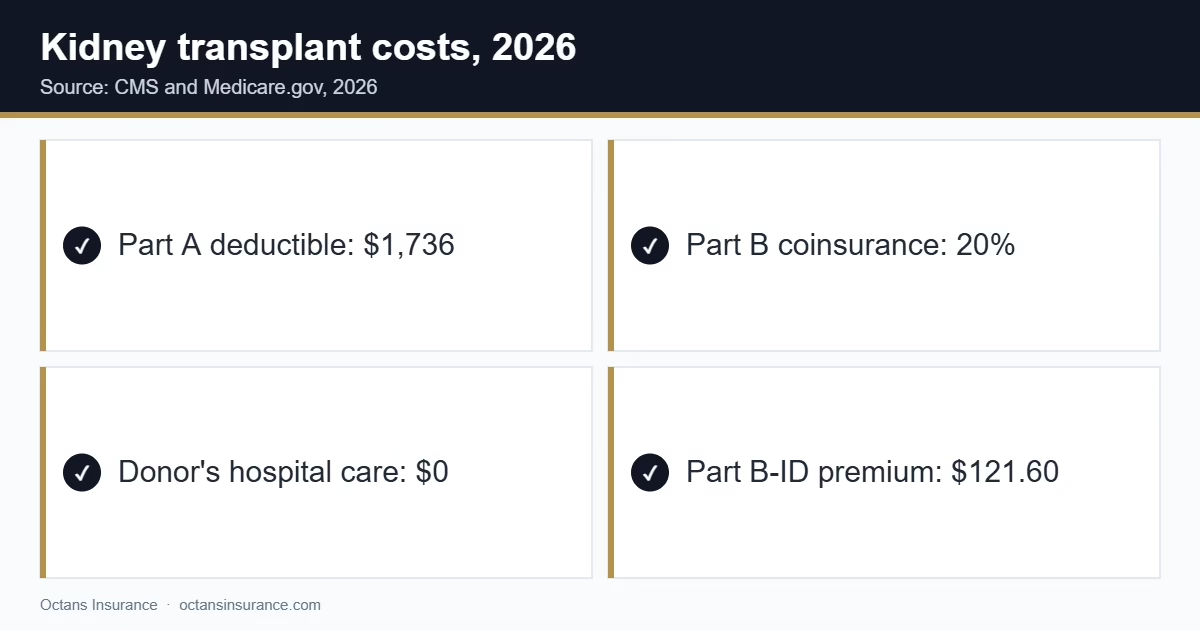
Does Medicare cover kidney transplant surgery? Yes. Part A covers the hospital stay, tests and your donor’s full care. Part B covers your surgeons and your anti-rejection drugs if Medicare helped pay for the transplant. The surgery must be in a Medicare-certified transplant hospital. In 2026 you pay the $1,736 Part A deductible and 20% for Part B services.
Does Medicare cover kidney transplant surgery and hospital care?
Yes, and the bill for Medicare and kidney transplant care is split between Part A and Part B. The table follows the Medicare.gov kidney transplant coverage page.
| Part A (hospital insurance) helps pay for | Part B (medical insurance) helps pay for |
|---|---|
| Inpatient services in a Medicare-certified hospital | Doctors’ services for transplant surgery, including care before, during and after |
| The kidney registry fee | Doctors’ services for your kidney donor during their hospital stay |
| Lab and other tests to evaluate you and possible donors | Transplant (immunosuppressive) drugs, if Medicare helped pay for the transplant |
| Finding the right kidney if there’s no donor | Part of the cost of blood |
| Extra inpatient care your donor needs if surgery causes problems | |
| The full cost of your donor’s care, before, during and after surgery | |
| Blood, including the cost of processing it and giving it to you |
Source: Medicare.gov kidney transplants coverage page, as of November 2026.
Part B’s drug coverage includes standard and compounded immunosuppressive drugs. If you have kidney failure and also need a pancreas transplant, the official Medicare Coverage of Kidney Dialysis & Kidney Transplant Services booklet says Medicare covers it when it’s done at the same time as, or after, the kidney transplant.
Dialysis and kidney disease education are separate benefits with their own rules. Our Medicare and ESRD guide covers eligibility and the 30-month rule for people with job-based coverage.
Where must the transplant happen for Medicare to pay?
Original Medicare covers your kidney transplant only if it’s done in a hospital that’s Medicare-certified to do kidney transplants. That rule also controls your drug coverage later, so confirm the hospital’s status early.
Does Medicare cover kidney transplant tests at other hospitals? There’s a little more room here. The booklet says Medicare covers lab and other tests at the certified hospital where you’ll get your transplant, or at another hospital that participates in Medicare.
Does Medicare cover kidney transplant care the same way in Medicare Advantage? Not exactly. The booklet says you might be able to use hospitals outside a plan’s network and service area for a transplant, but you have to check with the plan. Medicare.gov also tells people on a transplant waiting list to confirm before joining that their doctors, providers and hospitals are in the network, and to check the plan’s prior authorization rules.
One payment detail helps explain this. Since January 1, 2021, the CMS 2021 rate announcement says Medicare Advantage plans no longer pay kidney acquisition costs for their members. Original Medicare covers those costs instead.
When does Medicare cover kidney transplant costs for new enrollees?
If you’re not on dialysis and qualify for Medicare because of kidney failure, your coverage can start around the transplant. The Medicare.gov ESRD page sets two rules:
- Coverage can begin the month you’re admitted to a Medicare-certified hospital for the transplant, or for care you need before it, if the transplant happens that month or within the next 2 months.
- If the transplant is delayed more than 2 months after that admission, coverage can begin 2 months before the month of the transplant.
Say you’re admitted for pre-transplant care on January 12 and the transplant happens in March. Coverage can start in January. If the transplant slips to May, coverage would start in March instead, 2 months before the surgery.
You still have to apply through Social Security, and you need both Part A and Part B for the full transplant benefit. Medicare for kidney transplant patients is also available to children through a parent’s work record. The Medicare.gov children’s kidney transplant page lists the same core services.
Does Medicare pay for kidney transplant donor costs?
Yes. Your living donor’s care is paid in full by Medicare, from testing before surgery through the operation and recovery. No deductible or coinsurance applies to the donor’s hospital stay, for you or for the donor.
Does Medicare pay for kidney transplant donor complications too? Yes. Coverage includes the donor’s care before surgery, the surgery and care afterward. If the donor has problems from surgery and needs extra inpatient care, Part A helps pay. Part B covers doctors’ services for the donor during the hospital stay.
If you’re in a Medicare Advantage plan, your costs and coverage for living donors can be different and plan-specific. The Medicare & You 2027 handbook says to check the plan’s rules on coverage for living donors before you join.
Does Medicare cover kidney transplant drugs after surgery?
Does Medicare pay for kidney transplant drugs? Yes, with conditions. You’ll need immunosuppressive drugs for the rest of your life to keep your body from rejecting the new kidney. If kidney failure is your only reason for having Medicare, two conditions decide whether Part B pays for them:
- Part A was already in effect when you had the transplant.
- The surgery took place at a Medicare-certified facility.
Drug coverage begins only once your Part B is active, and it doesn’t reach back to earlier months. You pay 20% of the Medicare-approved amount after the Part B deductible.
If you don’t meet those conditions, Medicare drug coverage can step in. Part D covers immunosuppressive drugs when Part B doesn’t. See our guide to Medicare Part D for how plans and costs work.
How long the coverage lasts depends on why you have Medicare. People who had Medicare through age or disability before their kidneys failed keep transplant-drug coverage with no time limit. So do people who qualify by age or disability after a transplant Medicare paid for, and people whose private insurance paid for their care before their Part A began. Our page on Medicare and disability explains that route.
What happens to Medicare 36 months after a kidney transplant?
If you have Medicare only because of kidney failure, Medicare for kidney transplant patients ends 36 months after the month of your transplant. Coverage resumes if you start dialysis again or get another transplant within those 36 months. This is the part of Medicare and kidney transplant planning people most often miss.
Your drugs don’t have to stop when full Medicare does. Since 2023, the Part B immunosuppressive drug benefit, often called Part B-ID, keeps paying for transplant drugs only. To qualify, your Medicare must have been based on ESRD when you had the transplant, and you can’t have certain other coverage. The CMS general information manual, chapter 2 lists that coverage: group or individual health plans, VA drug coverage, TRICARE for Life, Marketplace plans, and Medicaid or CHIP that covers these drugs.
Part B-ID covers nothing else, and Medicare says it isn’t a substitute for full health coverage. There are no enrollment periods and no late enrollment penalty. If you file before your ESRD Medicare ends, Part B-ID starts the month after it ends. If you get other coverage later, you must tell Social Security within 60 days.
The CMS 2026 fact sheet sets the standard Part B-ID premium at $121.60 a month. Higher incomes pay more:
| Modified adjusted gross income, individual return | Modified adjusted gross income, joint return | 2026 monthly Part B-ID premium |
|---|---|---|
| $109,000 or less | $218,000 or less | $121.60 |
| Over $109,000 to $137,000 | Over $218,000 to $274,000 | $202.70 |
| Over $137,000 to $171,000 | Over $274,000 to $342,000 | $324.30 |
| Over $171,000 to $205,000 | Over $342,000 to $410,000 | $445.90 |
| Over $205,000 and under $500,000 | Over $410,000 and under $750,000 | $567.50 |
| $500,000 or more | $750,000 or more | $608.10 |
Source: CMS, “2026 Medicare Parts A & B Premiums and Deductibles” fact sheet. Married people filing separately use a different scale. The deductible is $283 in 2026, then you pay 20%. Our IRMAA guide explains how these income brackets work.
What you pay: Medicare and kidney transplant costs in 2026
Does Medicare pay for kidney transplant care in full? No. With Original Medicare in 2026, you pay:
- Hospital stay: the $1,736 Part A deductible per benefit period, $0 coinsurance for days 1 to 60 and $434 a day for days 61 to 90.
- Doctors and transplant drugs: the $283 Part B deductible, then 20% of the Medicare-approved amount.
- Lab tests: nothing for Medicare-approved tests.
- Your donor’s care: nothing.
Original Medicare has no yearly out-of-pocket limit. Medigap can help with the deductibles and 20%, though not every company sells it to people under 65. A Medicare Savings Program (QMB, SLMB or QI) may help pay Part B-ID costs if your income and resources are limited.
Hypothetical example: Daniel, 48, has Medicare only because of kidney failure. He gets a kidney in April 2026 at a certified hospital and goes home after 6 days. He owes the $1,736 Part A deductible, nothing for his donor’s stay, and 20% of his surgeons’ approved charges after the $283 Part B deductible.
His ESRD Medicare runs through the 36th month after his transplant month, so it ends after April 2029. If he files for Part B-ID before then, it starts May 1, 2029. At 2026 rates, a year of Part B-ID would cost 12 × $121.60 = $1,459.20 in premiums plus the $283 deductible, or $1,742.20 before his 20% share of drug costs. A year of full Part B premiums at 2026 rates would be 12 × $202.90 = $2,434.80. Amounts for 2029 will differ.
How to get a kidney transplant covered by Medicare
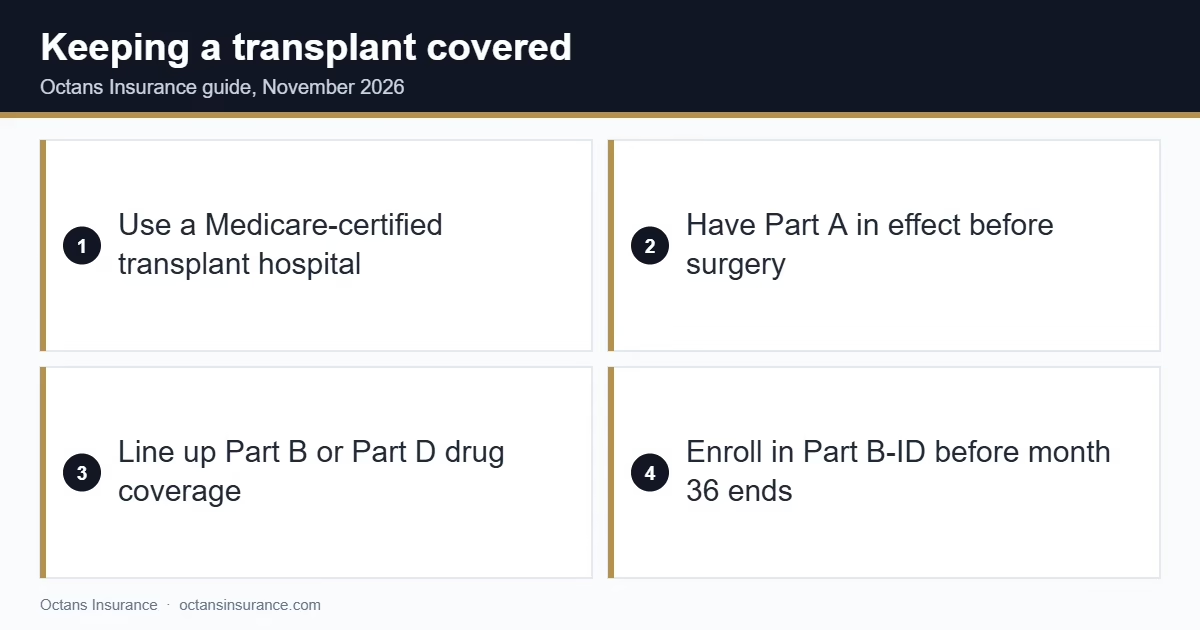
- Apply for Medicare early. Contact Social Security at 1-800-772-1213 or your local office, and sign up for Part A and Part B.
- Confirm the hospital is Medicare-certified for kidney transplants. This protects both the surgery claim and your future drug coverage.
- Make sure Part A is in effect before the transplant. If you have ESRD-only Medicare, that’s a condition for Part B drug coverage.
- Check plan networks. In Medicare Advantage, confirm your transplant center, surgeons, prior authorization rules and living donor coverage.
- Line up drug coverage. Know whether Part B, Part D or another plan will pay for anti-rejection drugs.
- Plan for month 36. If your Medicare is based only on ESRD, call 1-877-465-0355 to enroll in Part B-ID, or file Form CMS-10798.
Questions to ask your transplant team and plan:
- Is this hospital Medicare-certified for kidney transplants?
- Which of my costs fall under Part A and which under Part B?
- Will my donor get any bills, and who should they call if they do?
- Which pharmacy will fill my immunosuppressive drugs, and under which part?
- When does my Medicare end, and will I qualify for Part B-ID?
Does Medicare cover kidney transplant: frequently asked questions
Does Medicare cover a kidney transplant if I’m under 65?
Yes. If you have permanent kidney failure and qualify through your own, your spouse’s or a parent’s work record, you can get Medicare at any age. You must apply through Social Security. You’ll need both Part A and Part B for the full transplant benefit, and the surgery must be done in a Medicare-certified transplant hospital.
Does my kidney donor pay anything?
Not under Original Medicare. Part A pays for all of the donor’s care: the workup before surgery, the operation and recovery. The donor’s hospital stay carries no deductible or coinsurance for either of you, and Part B covers the donor’s doctors while they’re in the hospital. If you’re in a Medicare Advantage plan, check its rules for living donors before you join, since coverage can be plan-specific.
How long does Medicare pay for anti-rejection drugs?
It depends on why you have Medicare. With Medicare based on age or disability, Part B pays with no time limit if Medicare helped pay for the transplant. With Medicare based only on kidney failure, full coverage ends 36 months after the transplant month, but the Part B-ID benefit can keep paying for the drugs.
What does Part B-ID cost in 2026?
The standard monthly premium is $121.60 in 2026, and it rises with income, up to $608.10 at the highest income levels. The yearly deductible is $283. After that you pay 20% of the Medicare-approved amount for your immunosuppressive drugs. People with limited income may get help through a QMB, SLMB or QI program from their state.
Can I join Medicare Advantage before a kidney transplant?
Yes. Everyone eligible for Medicare with ESRD can join a Medicare Advantage plan since January 1, 2021, once they have Part A and Part B. Before joining, check that your transplant hospital, surgeons and other providers are in the network, and review the plan’s prior authorization rules, drug coverage and costs. Costs and rules vary by plan.
Does Medicare cover a second kidney transplant?
It can. Does Medicare cover kidney transplant care a second time on the same terms? If your ESRD Medicare is still active, the same rules apply. If you get another transplant or restart dialysis within 36 months after a transplant, your Medicare coverage resumes. If it happens after 36 months, Medicare says coverage starts right away when you sign up again, without the usual waiting period.

How a licensed Octans agent can help
Octans Insurance is an independent agency, not a government office, and we can’t change what Medicare and kidney transplant rules allow. Our licensed agents compare Medigap, Medicare Advantage and Part D options from more than 120 carriers in the 19 states where we work. For people facing a transplant, we check whether your transplant center and surgeons are in a plan’s network, how each plan covers anti-rejection drugs, and whether Medigap is open to you at your age.
For unbiased help, contact your State Health Insurance Assistance Program (SHIP) through shiphelp.org, or call 1-800-MEDICARE (1-800-633-4227; TTY 1-877-486-2048). Questions about your treatment belong with your transplant team.
A transplant can also change your life insurance options; our guide to life insurance with kidney disease explains what insurers look at. To review your Medicare choices, call (617) 935-9220.
Keep Reading: Related Guides
- Medicare and ESRD guide
- How Medicare Part D works
- Life insurance with kidney disease
- Does Medicare Cover Dialysis? What Parts A and B Pay in 2026
- Does Medicare Cover Respite Care for Family Caregivers?
We do not offer every plan available in your area. Please contact Medicare.gov or 1-800-MEDICARE to get information on all of your options.
This article is for general information and is not tax, legal, or medical advice.
About examples and tools: Hypothetical examples, sample rates, calculators and quizzes on this site are for general educational and illustrative purposes only. They are not quotes, offers of coverage, or guarantees of eligibility, approval, price or benefits, and they are not legal, tax, financial or medical advice. The insurance company decides eligibility and price; Medicare rules are set by CMS and the Social Security Administration. Octans Insurance is not connected with or endorsed by the U.S. government or the federal Medicare program.
Compare Medicare coverage before your transplant
Start with a free, no-obligation quote review with a licensed Octans agent.
(617) 935-9220 | life@octansinsurance.com