
Final Expenses
Will a Funeral Home Wait for Life Insurance to Pay?
Can a funeral home wait for life insurance money? This guide explains funeral home assignments, state claim-payment deadlines, what to bring to the arrangement meeting, and your options when there’s no policy.
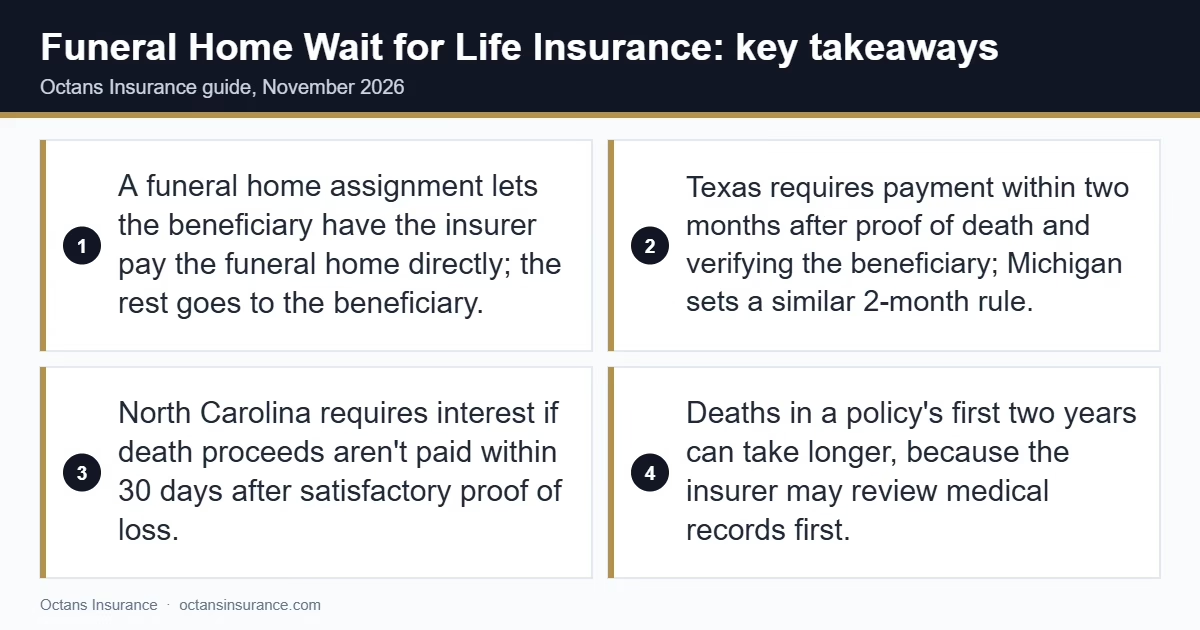
- A funeral home assignment lets the beneficiary have the insurer pay the funeral home directly; the rest goes to the beneficiary.
- Texas requires payment within two months after proof of death and verifying the beneficiary; Michigan sets a similar 2-month rule.
- North Carolina requires interest if death proceeds aren’t paid within 30 days after satisfactory proof of loss.
- Deaths in a policy’s first two years can take longer, because the insurer may review medical records first.
Table of Contents
Make sure your family is financially protected today!
Will a funeral home wait for life insurance to pay? It can, through a funeral home assignment: the beneficiary signs a form that lets the insurer pay the funeral home directly from the death benefit, and the rest still goes to the beneficiary. Ask each funeral home whether it accepts assignments, and know that a new or disputed policy can slow the claim.
This guide explains how a funeral home assignment works, how fast insurers must pay in several Octans states, what to bring, and what to do if there’s no policy. For the claim itself, see our guide on how to file a life insurance claim.
Will a funeral home wait for life insurance to pay?
Insurers do pay funeral homes this way. The federal employees’ life insurance program is a clear example. The Office of Personnel Management says its insurer “can pay FEGLI benefits to a funeral home if that’s what the person entitled to the money wants to happen,” and adds, “Funeral homes have the form to do this.”
Can every funeral home wait for life insurance? We found no official rule that requires a funeral home to accept an assignment or sets how long it must wait, so policies differ. Before you commit, ask whether it accepts an assignment, whether it wants a deposit, and whether it will call the insurer to confirm the policy first.
Waiting on the money doesn’t mean waiting on the care. Florida’s funeral regulator says “a body must be embalmed or refrigerated within 24 hours of death,” and the FTC notes that some states require embalming or refrigeration if burial or cremation doesn’t happen within a set time. Ask what refrigeration costs per day while paperwork is sorted out.
Under the FTC Funeral Rule, you also have the right to “a written statement after you decide what you want, and before you pay.” That itemized total is the amount you’d assign.
How does a funeral home assignment work?
A funeral home assignment is paperwork that redirects part of a death benefit. New York Life, a life insurer, describes it in its beneficiary FAQ as “a written agreement between a beneficiary and a funeral home authorizing the insurer to direct payment of some or all of the policy proceeds to the funeral home.”
The person entitled to the money signs it. OPM’s death claim form asks the claimant, “Have you signed a document with a funeral home that authorizes us to make a payment directly to them?” If yes, a copy goes in with the claim. Timing matters: New York Life says it honors an assignment it receives “in good order before the claim is settled.”
There are two kinds to know about:
- At-need assignment: Signed by the beneficiary after the death to cover that funeral. This is the kind that applies when a family asks a funeral home to wait for life insurance.
- Preneed assignment: Signed by the policy owner before death. A Maryland Board of Morticians form for an irrevocable assignment says the funeral home is paid only after it provides a certified death certificate and a final contract, the payment “shall not exceed the total amount of the funeral bill,” and any excess goes to the named beneficiaries. The FTC notes that some state laws require funeral homes to put part of a prepayment in a trust or to buy a life insurance policy with the death benefits assigned to the funeral home.
Hypothetical example: Lena’s father had a $12,000 final expense policy naming her as beneficiary. It had been in force for six years, so it was past the two-year contestable period. The funeral home’s itemized statement totals $8,300, the NFDA’s 2023 national median for a funeral with viewing and burial. (The policy amount is made up.)
- Lena signs a funeral home assignment for $8,300, the amount on the itemized statement.
- Once the claim is approved, the insurer pays the funeral home $8,300.
- Lena receives the rest: $12,000 − $8,300 = $3,700.
- If the policy had been only one year old, the insurer could review her father’s records first, which can delay payment, so the funeral home might ask for a deposit.
How long will a funeral home wait for life insurance?
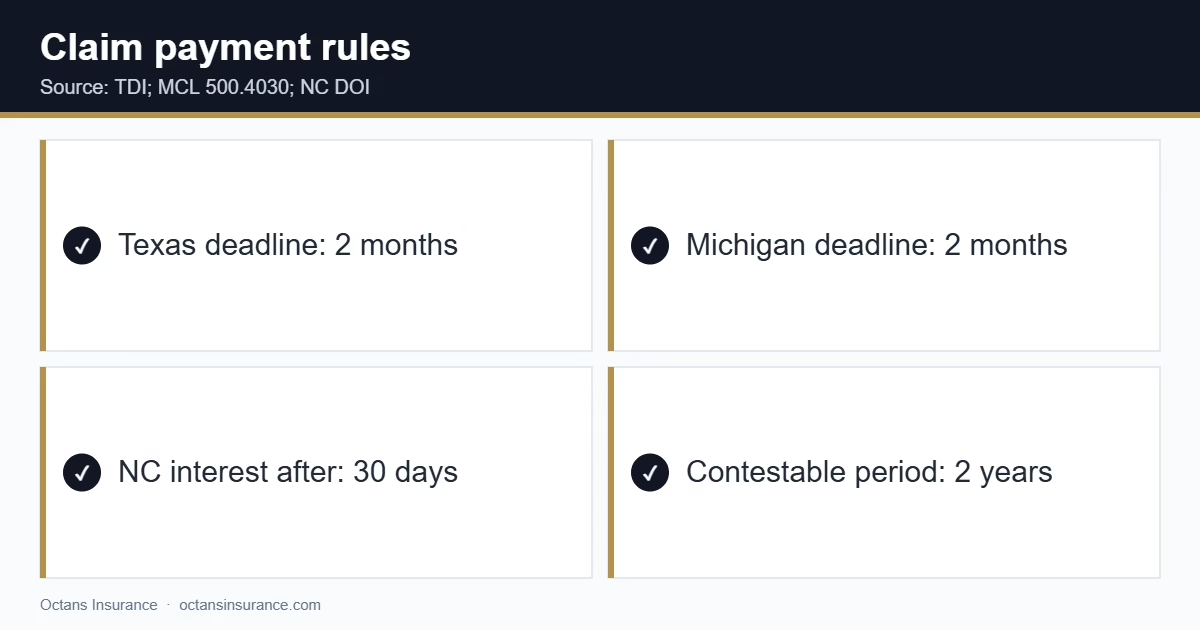
How long can a funeral home wait for life insurance? That depends on how fast the insurer pays once it has the paperwork. Several Octans states set deadlines or interest rules:
| State | Rule for paying death claims | Source |
|---|---|---|
| Texas | Pay within two months after proof of death and verifying the beneficiary; individual policies also owe interest from proof of death | Texas Department of Insurance |
| Michigan | Settle on receipt of due proof of death, or no later than 2 months after it | Mich. Comp. Laws § 500.4030 |
| North Carolina | Interest is owed if proceeds aren’t paid within 30 days after satisfactory proof of loss | N.C. Department of Insurance (G.S. 58-58-110) |
| Florida | Lump-sum claims include interest from the date the insurer receives written proof of death and all requested documents | Florida Department of Financial Services |
| Ohio | Interest from the date of death to the date of payment, if the insured lived in Ohio and the beneficiary elects a lump sum | Ohio Rev. Code § 3915.052 |
Sources: the Texas Department of Insurance, Michigan Legislature, N.C. Department of Insurance, Florida Department of Financial Services and Ohio Revised Code, read November 6, 2026.
These rules apply to insurers, not funeral homes. Most run from when the insurer has proof of death and what it needs to verify the claim, so a missing form can push the clock back. Our guide on finding a lost life insurance policy helps if you know there’s coverage but can’t find the paperwork.
Can a funeral home wait for life insurance during the contestable period?
It’s harder. If the insured dies in the first two years of a policy, Florida’s regulator says the insurer “has the right to review the insured’s medical history before they pay or deny a claim,” which “could mean a delay in receiving death benefits.” The Texas Department of Insurance adds that the company “may also investigate the cause of death.”
A funeral home may still accept the assignment, but expect questions. It may ask for a deposit or another way to pay in case the claim is delayed or denied. If a claim is denied in Texas for a misstatement, TDI says the company “must return the premiums to your beneficiary.” Our guide to the life insurance contestability period explains what the insurer can review.
What to bring when you meet the funeral home
To help the funeral home wait for life insurance money, bring the right papers to your arrangement meeting. They can save days:
- The policy, or at least the insurance company’s name and the policy number.
- Your photo ID, and proof that you’re the beneficiary if you have it.
- The deceased’s Social Security number. Social Security says to give it “to the funeral director because they usually report the person’s death to us.”
- Certified death certificates, or a plan to get them. OPM says the funeral director “or your state bureau of vital statistics can usually provide a certified copy.”
- Court appointment papers if the estate is the beneficiary. OPM asks estate claimants for “a copy of the appointment papers issued by the court.”
- Details of any other coverage, such as group life through work or a prepaid funeral contract.
How to assign life insurance to a funeral home
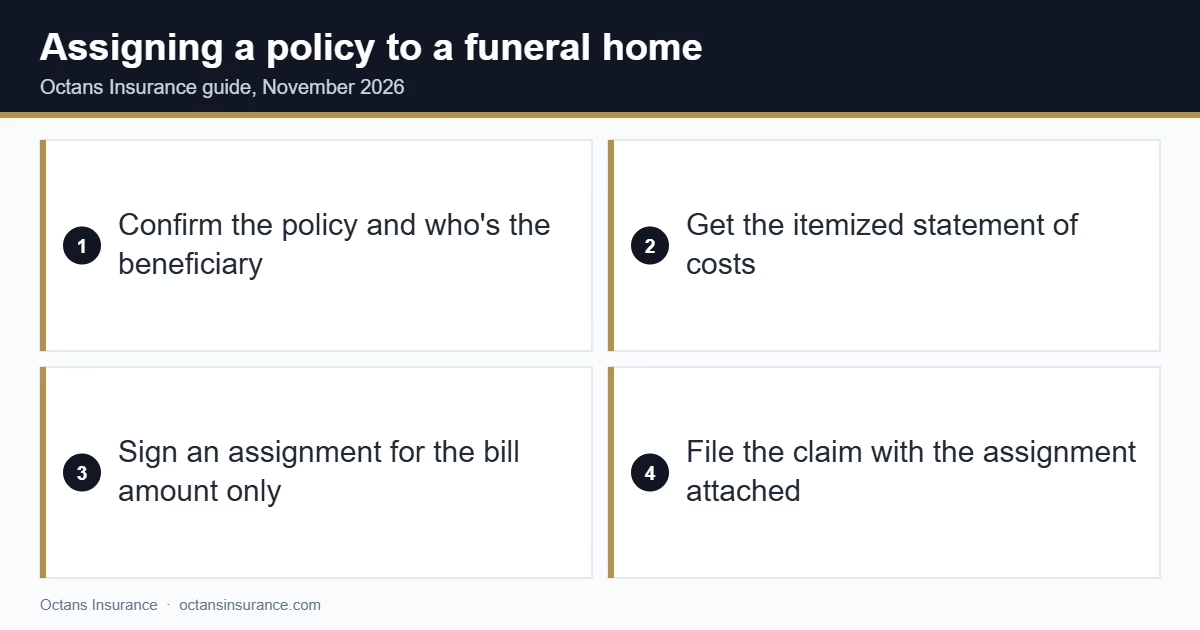
Here’s how to assign life insurance to a funeral home without giving away more than the bill:
- Confirm the policy and the beneficiary. Call the insurer, give the policy number, and ask who’s named and whether the policy is in force.
- Ask the insurer about assignments. Ask whether it accepts funeral home assignments, which form it wants and where to send it.
- Get prices first. The FTC says funeral directors must give price information by phone, and you get a General Price List to keep.
- Choose the services, then get the itemized statement. It shows each item and the total.
- Assign only the bill. Write the dollar amount from the statement on the assignment, not the full death benefit.
- File the claim with the assignment attached. Send the claim form, a certified death certificate and the assignment together.
- Track payment. Confirm the funeral home was paid and that the balance came to you.
What if there’s no policy or the funeral home won’t wait?
If you can’t make a funeral home wait for life insurance, or there’s no policy, you still have choices. The FTC says “Direct cremation usually costs less than the ‘traditional’ full-service funeral,” and so does immediate burial. Calling several funeral homes for prices can also lower the bill.
- Social Security: “A spouse might get a one-time death benefit payment of $255.” If there’s no spouse, some children may qualify, and you must apply within 2 years. See our Social Security death benefit guide.
- Veterans benefits: VA offers a burial allowance and a plot or interment allowance to help cover some costs for eligible veterans. See veterans burial benefits.
- County help: Florida’s regulator says “Indigent burials or cremations are handled by the city or county where the burial is to take place.” In Alabama, Mobile County bases eligibility on federal poverty guidelines and generally grants a cremation. Escambia County, Florida, says its program “provides cremation only,” and if the person doesn’t qualify, the next of kin must arrange to pay any expenses incurred.
- The estate: Funeral costs can often be repaid from the estate. Our guide on who pays for funeral costs explains how.
Funeral home wait for life insurance: frequently asked questions
Do funeral homes accept life insurance as payment?
They can, through a funeral home assignment, where the beneficiary authorizes the insurer to pay the funeral home directly. OPM says, “Funeral homes have the form to do this.” No rule we found requires a funeral home to accept one, so ask each funeral home whether it takes assignments, whether it needs a deposit, and whether it verifies the policy with the insurer first.
Who signs a funeral home assignment?
The beneficiary, meaning the person entitled to the money. OPM’s claim form asks the claimant whether they signed a document authorizing direct payment to a funeral home. If there are several beneficiaries, ask the insurer whether each must sign for their share. A minor can’t receive the money directly; the NAIC says “Insurance companies won’t pay a minor.”
Can the funeral home get more than the funeral bill?
Not if you assign only the bill. Write in only the amount on the itemized statement the FTC Funeral Rule entitles you to before you pay. Maryland’s form for preneed assignments says payment to the funeral home “shall not exceed the total amount of the funeral bill,” with any excess paid to the named beneficiaries. Keep a copy of everything you sign.
How long will a funeral home wait for life insurance money?
That depends on how fast the insurer pays, which varies by state and claim. Texas requires payment within two months after proof of death and verifying the beneficiary, and Michigan within 2 months of due proof. North Carolina adds interest after 30 days. A death within the two-year contestable period can take longer because the insurer may review medical records first.
Can I set up an assignment before death?
Yes, a policy owner can. New York Life says some policyowners enter into a collateral assignment with a funeral home before the insured’s death, and Maryland’s Board of Morticians publishes an irrevocable assignment form. Compare that with prepaid funeral contracts in our preneed vs. final expense insurance guide before you decide.

How a licensed Octans agent can help
If you’re planning ahead so your family never has to ask whether a funeral home will wait for life insurance money, final expense insurance is one option among several, along with savings, a prepaid funeral contract or existing coverage. A licensed Octans agent can explain how final expense insurance works, including waiting periods that can affect an early claim, and compare 120+ carriers in 19 states.
If a loved one just died and you’re the beneficiary, we can help you find the insurer’s claims contact and explain the forms. We can’t promise how fast an insurer pays or whether a funeral home will accept an assignment. Call (617) 935-9220 to talk with a licensed agent.
Keep Reading: Related Guides
- How to file a life insurance claim
- Final expense insurance
- Who pays for funeral costs
- How to Plan a Funeral
- Does Life Insurance Go Through Probate? Rules and Exceptions
Important: Octans Insurance agents are licensed in the states in which they operate. Coverage availability and rates may vary by state. Premium examples, when provided, are illustrative samples from published sources, not quotes. Final rates are determined by the insurance carrier based on underwriting and applicable policy criteria. Policy terms, exclusions, limitations, riders, and availability vary by carrier and state.
About examples and tools: Hypothetical examples, sample rates, calculators and quizzes on this site are for general educational and illustrative purposes only. They are not quotes, offers of coverage, or guarantees of eligibility, approval, price or benefits, and they are not legal, tax, financial or medical advice. The insurance company decides eligibility and price; Medicare rules are set by CMS and the Social Security Administration.
Plan ahead so your family isn’t waiting on a claim
Start with a free, no-obligation quote review with a licensed Octans agent.
(617) 935-9220 | life@octansinsurance.com