
Talking to Parents About Final Wishes: A Holiday Guide
Talking to Parents About Final Wishes: The Short Answer
Talking to parents about final wishes goes best as a short, calm conversation. Lead with your own reasons, ask about coverage, beneficiaries and where documents are kept, note burial or cremation wishes, write one summary for the whole family, and agree on a single follow-up step after the holiday.
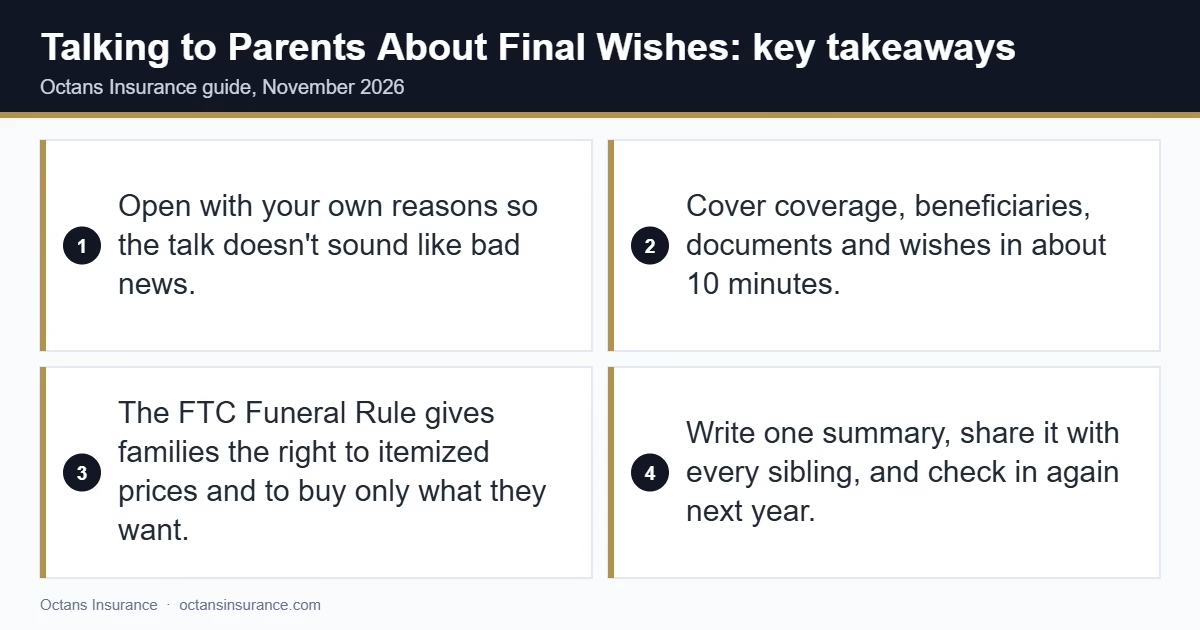
- Open with your own reasons so the talk doesn’t sound like bad news.
- Cover coverage, beneficiaries, documents and wishes in about 10 minutes.
- The FTC Funeral Rule gives families the right to itemized prices and to buy only what they want.
- Write one summary, share it with every sibling, and check in again next year.
Table of Contents
Make sure your family is financially protected today!
Talking to parents about final wishes works best as a short, kind conversation, not one big talk. Over the holidays, ask a few open questions, cover three basics (coverage, beneficiaries and where documents are), note any burial or cremation wishes, and agree on one follow-up step before everyone heads home.
Why the holidays are a good time for talking to parents about final wishes
Thanksgiving falls on Thursday, November 26 this year. For many families, it is one of the few times everyone is in the same room. You can look at paperwork together, and nobody has to explain things twice over the phone.
Planning ahead also takes pressure off later. According to the FTC, shopping for funeral arrangements in advance lets people compare prices without time pressure and creates a chance for family discussion. That is the goal here: a calm talk now, so no one has to guess later.
Pick a quiet moment, not the dinner table. A walk, a coffee the next morning or a drive often works better. Keep it to 10 or 20 minutes. And remember whose plan it is. Your job is to listen and write things down, not to decide.
How to open the conversation without alarm
If you’ve wondered how to talk to parents about end of life planning, the first few sentences matter most. Most parents worry that the topic means something is wrong. Lead with your own reasons, and make it clear nothing prompted it. Some openers that tend to land gently:
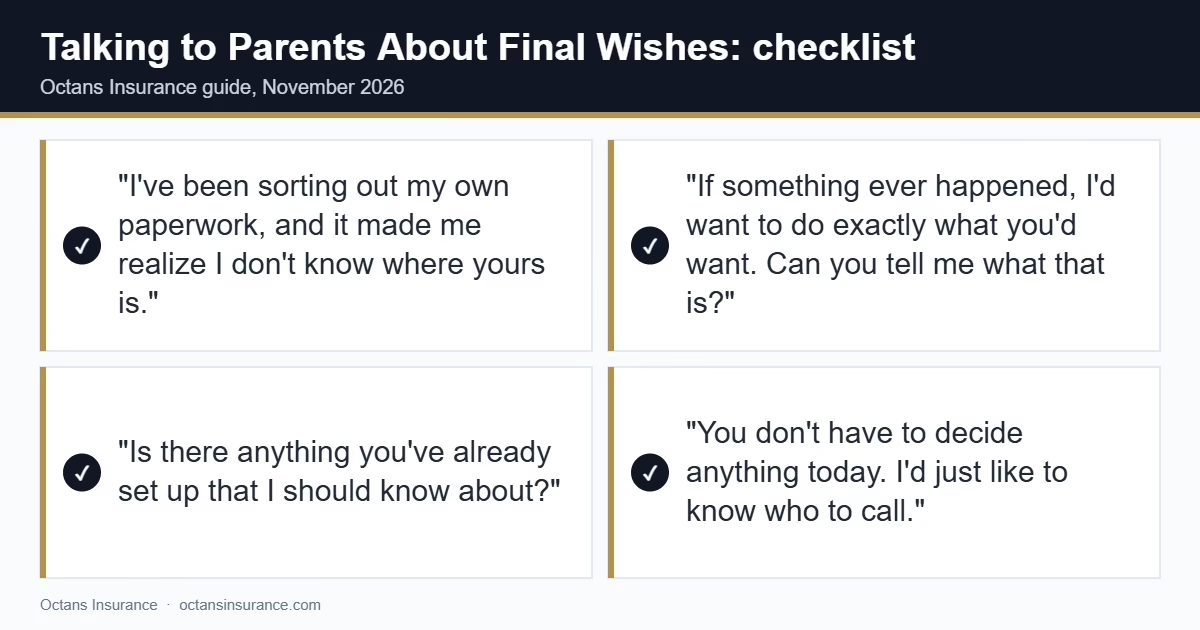
- “I’ve been sorting out my own paperwork, and it made me realize I don’t know where yours is.”
- “If something ever happened, I’d want to do exactly what you’d want. Can you tell me what that is?”
- “Is there anything you’ve already set up that I should know about?”
- “You don’t have to decide anything today. I’d just like to know who to call.”
If a parent says “not now,” accept it. Ask if there is a better time this weekend or after the holidays. A no today is often a yes in a month, especially if you leave without pushing.
A 10-minute agenda: coverage, beneficiaries, documents
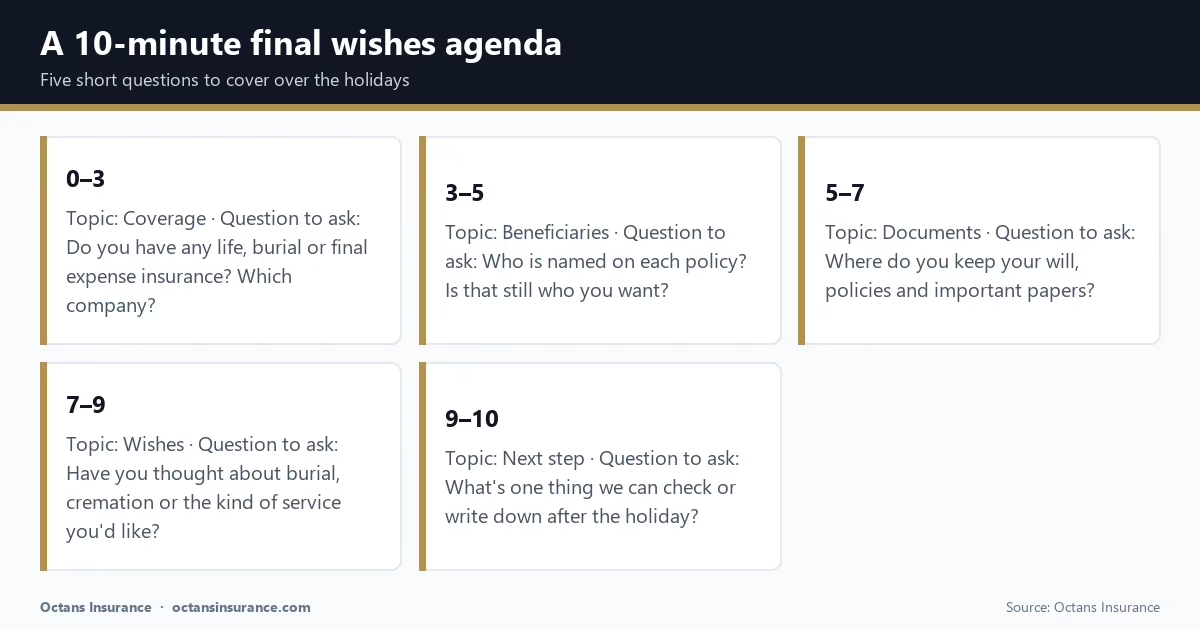
When talking to parents about final wishes, it helps to have a short plan. You don’t need every answer. You need to know what exists and where it is. This agenda fits in about 10 minutes.
| Minutes | Topic | Question to ask |
|---|---|---|
| 0–3 | Coverage | “Do you have any life, burial or final expense insurance? Which company?” |
| 3–5 | Beneficiaries | “Who is named on each policy? Is that still who you want?” |
| 5–7 | Documents | “Where do you keep your will, policies and important papers?” |
| 7–9 | Wishes | “Have you thought about burial, cremation or the kind of service you’d like?” |
| 9–10 | Next step | “What’s one thing we can check or write down after the holiday?” |
Beneficiaries matter more than many people expect. The NAIC notes that money paid to an estate typically goes through probate, while naming individuals lets them receive proceeds right away. It also suggests reviewing beneficiaries every few years.
Burial, cremation and service wishes
Ask open questions and let your parent lead. Do they prefer burial or cremation? Is there a funeral home, place of worship or cemetery they have in mind? Any music, readings or people they want included? Have they already paid for anything in advance?
It also helps to know a few consumer rights. Under the FTC Funeral Rule, funeral homes must give price information by phone if you ask and a General Price List you can keep. You can buy only the items you want, use a casket or urn bought elsewhere, and use an alternative container for cremation.
For a rough sense of cost, the NFDA’s 2023 General Price List Study put the national median at $8,300 for a funeral with viewing and burial and $6,280 for a funeral with viewing and cremation. Those medians leave out cemetery costs, markers and cash-advance items such as flowers. You can estimate local costs with our funeral cost calculator.
For example, say your mother has a $10,000 policy and wants a funeral with viewing and burial. At the $8,300 national median, $1,700 would be left ($10,000 minus $8,300). That is before cemetery costs, which the median excludes. Her local funeral home’s price list would give the real number.
If your parent has no coverage
Some parents plan to use savings. Others assume a policy from work is still in force when it ended at retirement. If there is nothing set aside, that is useful to know now, not later.
One option is a small whole life policy, often called burial insurance. Adult children can help, but the parent must agree and sign the application. Our guide to life insurance on your parents explains who can own and pay for the policy.
As a reference point only, a published sample on our burial insurance page shows $71 a month for a 75-year-old woman and $97 a month for a 75-year-old man, for $10,000 of non-tobacco, simplified issue coverage. Those samples were valid March 9, 2026. They are an illustration, not a quote. Actual prices depend on health answers, state and carrier.
Plans with no health questions exist too. They usually have a two-year waiting period for natural-cause deaths, during which the benefit is typically the premiums paid plus interest.
Handling siblings and money tension
Money is where family talks most often go sideways. A few habits help. Share one written summary with every sibling, so no one feels left out. Agree that your parent’s wishes come first, even if someone disagrees. If siblings plan to share costs, write down who pays what.
Some adult children worry they will inherit a parent’s bills. According to the FTC, a person’s debts are paid from their estate, and family members usually don’t have to pay them from their own money. Exceptions include a co-signer, a spouse in a community property state or in a state that requires spouses to pay certain debts, such as some health care costs, and someone responsible for the estate who didn’t follow state probate law. For specific questions about wills or estates, talk with an elder law attorney.
What to write down and who keeps it
A one-page summary is enough to start. Your parent keeps the originals. At least two family members should know where the summary and the papers are. A final wishes checklist might include:
- Each insurance company name and policy number
- The primary and backup beneficiaries on each policy
- Where the will, power of attorney and health care forms are kept
- The preferred funeral home, cemetery or place of worship
- Burial or cremation preference and any service wishes
- Any prepaid funeral contract and the company that holds it
- Military discharge papers, if your parent served
- Who to call first, with phone numbers
Don’t write passwords or full account numbers in a shared copy. Note where those details are kept instead.
Following up after talking to parents about final wishes
Send your summary to your parent within a week and ask them to correct it. Then pick one small task, such as finding a policy or calling a funeral home for its price list.
Finding a living parent’s policy is easier with their help. The NAIC Life Insurance Policy Locator is free, but it does not search for policies on people who are alive. That makes this year’s conversation the best time to gather names and policy numbers. Our guide to finding a lost life insurance policy covers what to do if papers go missing later.
Finally, put a date on the calendar to check in again next year. The first end of life conversation is usually the hardest. Talking to parents about final wishes is not a single conversation. It is a habit that gets easier each time.
Keep Reading: Related Guides
- Burial insurance explained
- Life insurance on your parents
- Funeral cost calculator
- How to find a lost life insurance policy
- Who pays for funeral costs?
- Final Expense Insurance Scams
- Funeral Home Price List
Talking to Parents About Final Wishes: Frequently Asked Questions
How do I bring up final wishes with my parents?
Start with your own reasons, not theirs. Saying you’ve been organizing your own paperwork, or that you want to follow their wishes exactly, keeps the tone calm. Choose a quiet moment away from the group, keep it to 10 or 20 minutes, and make clear they don’t have to decide anything today. Listening and taking notes matters more than covering every topic in one sitting.
What questions should I ask my parents about their funeral?
Ask whether they prefer burial or cremation, which funeral home, cemetery or place of worship they have in mind, and whether they’ve prepaid anything. Ask about music, readings or people they want included. It also helps to know that under the FTC Funeral Rule, funeral homes must give you a General Price List and let you buy only the items you choose.
What if my parents don’t want to talk about death?
Accept the no and ask when a better time might be. Many parents are more open once they see the talk is about following their wishes, not about health or bad news. Try a smaller question instead, such as where they keep important papers. Leaving without pressure often makes a later conversation easier, whether that’s later in the weekend or after the holidays.
Can I buy burial insurance for my parents?
Yes, in most cases, but your parent must agree and sign the application. Insurers generally won’t issue a policy on an adult who doesn’t know about it. An adult child can often own the policy, pay the premiums and be the beneficiary. Policies with health questions may pay the full benefit sooner, while no-health-question policies usually have a two-year waiting period for natural-cause deaths.
How do I find out if my parent has burial insurance?
The simplest way is to ask your parent and look together for policy papers, premium notices or bank drafts to an insurance company. Write down the company name and policy number. The NAIC Life Insurance Policy Locator is free, but it only searches for policies on people who have died, so gathering details while your parent can help is the best approach.
This article is general information, not legal, tax, or medical advice. Premium examples are published samples, not quotes.
About examples and tools: Hypothetical examples, sample rates, calculators and quizzes on this site are for general educational and illustrative purposes only. They are not quotes, offers of coverage, or guarantees of eligibility, approval, price or benefits, and they are not legal, tax, financial or medical advice. The insurance company decides eligibility and price; Medicare rules are set by CMS and the Social Security Administration.