
Medicare Basics
Medicare vs Medicaid: Key Differences and How to Get Both
Medicare vs Medicaid side by side: who runs each program, who qualifies, what each covers and costs in 2026, who pays for nursing homes, and how Medicare Savings Programs and D-SNPs help people with both.
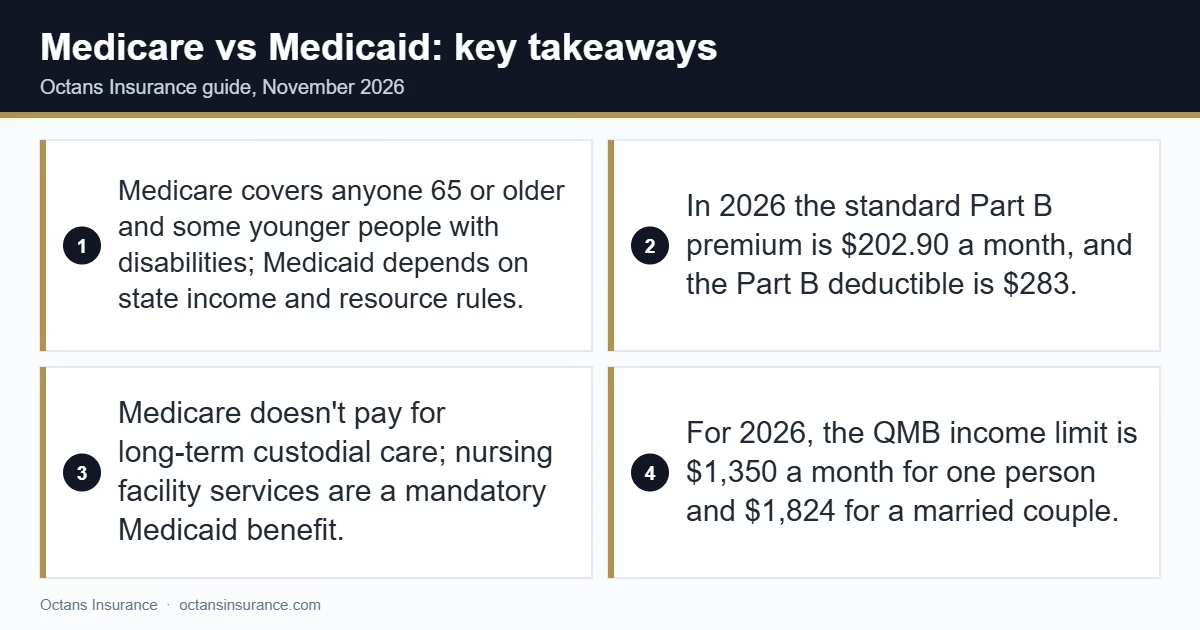
- Medicare covers anyone 65 or older and some younger people with disabilities; Medicaid depends on state income and resource rules.
- In 2026 the standard Part B premium is $202.90 a month, and the Part B deductible is $283.
- Medicare doesn’t pay for long-term custodial care; nursing facility services are a mandatory Medicaid benefit.
- For 2026, the QMB income limit is $1,350 a month for one person and $1,824 for a married couple.
Table of Contents
Make sure your family is financially protected today!
Medicare vs Medicaid comes down to who each program is for. Medicare is federal health insurance for people 65 and older and some younger people with disabilities, whatever their income. Medicaid is a joint federal and state program for people with limited income and resources, and its rules vary by state. If you qualify for both, you can have both.
Medicare vs Medicaid at a glance
Here is the Medicare and Medicaid difference in one table. Medicare dollar amounts are for 2026.
| Feature | Medicare | Medicaid |
|---|---|---|
| Who runs it | The federal government | Each state, under federal rules; states and the federal government share the cost |
| Who it’s for | People 65 or older, plus some younger people with a disability, End-Stage Renal Disease (ESRD) or ALS | Eligible low-income adults, children, pregnant women, older adults and people with disabilities |
| Income test | None to qualify | Yes. You generally must meet your state’s income and resource rules |
| What you pay | $202.90 Part B premium a month, $283 Part B deductible, $1,736 Part A deductible per benefit period, then usually 20% coinsurance | Most cost sharing is limited to nominal amounts, and some groups and services are exempt |
| Nursing home care | Short-term skilled nursing after a qualifying hospital stay; no long-term custodial care | Nursing facility services are a required benefit |
| Prescription drugs | Through a Part D plan or a Medicare Advantage plan with drug coverage | Optional benefit for states; if you also have Medicare, Medicare covers your drugs |
| Dental care | Doesn’t cover most dental care; some Medicare Advantage plans offer it (varies by plan and area) | Optional benefit; each state decides |
| Where to apply | Social Security | Your state Medicaid office |
Sources: CMS, 2026 Medicare Parts A and B premiums and deductibles fact sheet (Nov. 14, 2025); Medicare.gov and Medicaid.gov program pages, as of November 2026.
Who qualifies for Medicare or Medicaid, and who runs them?
Both programs sit under the Centers for Medicare & Medicaid Services (CMS), the federal agency that provides coverage through Medicare, Medicaid and the Children’s Health Insurance Program.
Medicare is federal health insurance for anyone age 65 and older. You may get it earlier if you have a disability, End-Stage Renal Disease or ALS. You sign up through Social Security, and about 99% of people with Medicare don’t pay a Part A premium because they have at least 40 quarters of Medicare-covered work. See our Medicare eligibility guide for the details.
Medicaid is administered by states, according to federal requirements, and funded jointly by states and the federal government. It covers eligible low-income adults, children, pregnant women, elderly adults and people with disabilities. Generally, you must meet your state’s rules for income and resources, plus other rules such as living in the state.
Age alone doesn’t qualify you for Medicaid. Turning 65 makes you eligible for Medicare, but Medicaid still depends on your finances. Some states let you “spend down” income that’s above the state’s Medicaid limit by paying non-covered medical expenses and cost sharing until your income is low enough to qualify.
What do Medicare and Medicaid cover?
Coverage is the next big Medicare vs Medicaid divide. Medicare has four parts. Part A helps cover inpatient hospital care, skilled nursing facility care, hospice and home health care. Part B helps cover doctors, outpatient care, medical equipment and many preventive services. Part D helps pay for prescription drugs. Medicare Advantage (Part C) is a private-plan alternative that bundles Parts A and B and usually Part D.
Medicare leaves gaps. In most cases it doesn’t cover dental services like routine cleanings, fillings or dentures, and it doesn’t pay for long-term care. Some Medicare Advantage plans offer dental, vision and hearing extras, which vary by plan and area. Our Medicare dental, vision and hearing guide explains the options.
Medicaid’s list is set by law and by each state. Every state must provide mandatory benefits, including inpatient and outpatient hospital services, physician services, lab and X-ray services, nursing facility services, home health services and transportation to medical care. States may add optional benefits, such as prescription drugs, dental services, eyeglasses, physical therapy, hospice and personal care.
How do Medicare vs Medicaid costs compare in 2026?
Medicare has set costs that change every year. For 2026, CMS announced these amounts:
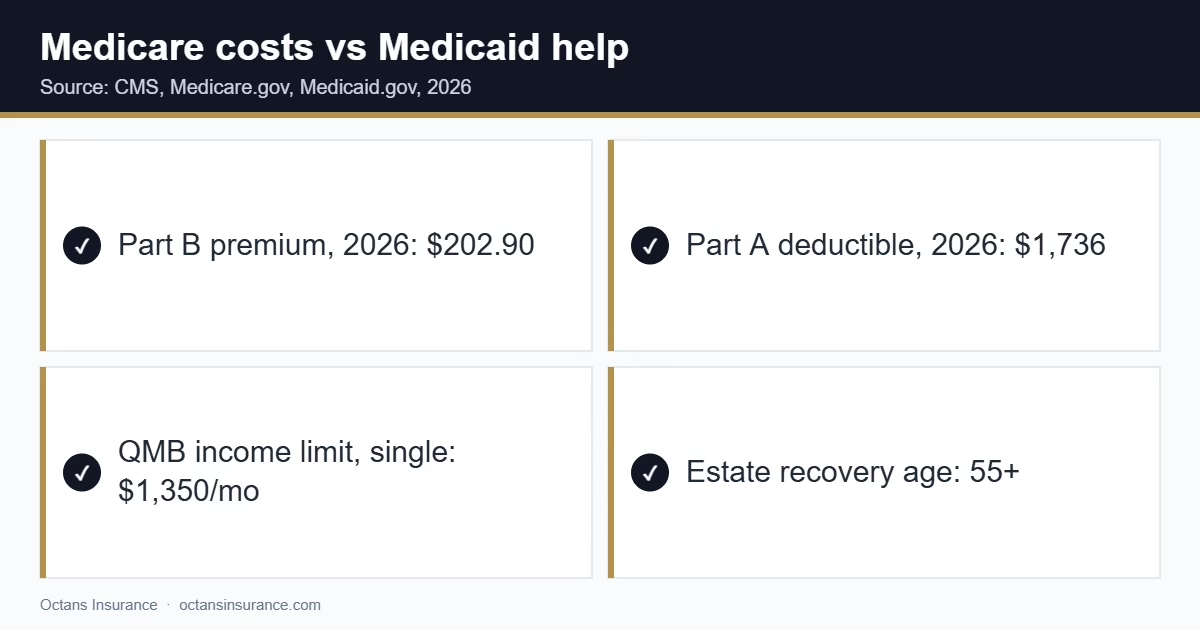
- Part B premium: $202.90 a month (the standard amount).
- Part B deductible: $283 a year. After that, you usually pay 20% of the cost of each covered service.
- Part A hospital deductible: $1,736 per benefit period, then $434 a day for days 61 to 90.
- Skilled nursing facility: $217 a day for days 21 to 100.
- Part A premium: none for about 99% of people. If you must buy Part A, it’s $311 or $565 a month, depending on your work history.
CMS announces 2027 amounts in the fall; check Medicare.gov.
Medicaid costs work differently. Under Medicaid.gov’s cost-sharing rules, states can charge copayments, coinsurance and deductibles on most benefits, but cost sharing for most services is limited to nominal or minimal amounts. Children, terminally ill people and people living in an institution are exempt. States can’t charge for emergency services, family planning, pregnancy-related services or preventive care for children.
Which program pays for long-term care?
Long-term care is a key Medicare vs Medicaid difference. Medicare doesn’t pay for long-term care, also called custodial care. That’s medical and non-medical care for people with a chronic illness or disability, mostly help with basic personal tasks of everyday life.
Medicare does cover short-term skilled nursing care after a medically necessary inpatient hospital stay of at least 3 days in a row. In 2026 you pay $0 for days 1 to 20 after the $1,736 deductible, $217 a day for days 21 to 100, and all costs after day 100.
Medicaid fills the long-term gap for people who qualify. Nursing facility services are a mandatory Medicaid benefit, and Medicaid offers benefits not normally covered by Medicare, like nursing home care and personal care services.
Plan for one catch. For enrollees age 55 or older, states must seek estate recovery for nursing facility services, home and community-based services, and related hospital and drug costs. States can’t recover if the enrollee is survived by a spouse, a child under 21, or a blind or disabled child of any age, and they must offer hardship waivers. An elder law attorney can explain how your state applies these rules.
Can you have Medicare and Medicaid at the same time?
Yes. People with both are called dual eligible. Medicare.gov explains that Medicare pays first for Medicare-covered services, and Medicaid pays last, after Medicare and any other insurance you have. If you have Medicare and Medicaid, most of your costs will be covered.
Your drug coverage moves to Medicare. You’ll be enrolled in a Medicare drug plan, and you’ll get Extra Help with drug costs automatically. Extra Help is a Medicare program, but full Medicaid coverage qualifies you for it. Our Medicare Extra Help guide covers how it works.
Dual Eligible Special Needs Plans (D-SNPs) are Medicare Advantage plans built for people with Medicare and Medicaid. All special needs plans must include Part D drug coverage, and D-SNPs can help coordinate your benefits between the two programs. You must live in a plan’s service area to join; our Medicare special needs plans page compares the types.
One more rule: insurance companies generally can’t sell you a Medigap policy if you have Medicaid.
Medicare Savings Programs: help short of full Medicaid
Medicare Savings Programs sit between Medicare and Medicaid. You may qualify for a Medicare Savings Program even without full Medicaid; one of them, QI, is only for people who don’t qualify for any other Medicaid coverage. These programs are run by your state:
- QMB (Qualified Medicare Beneficiary): helps pay Part A premiums if you owe them, plus Part B premiums, deductibles, coinsurance and copayments.
- SLMB and QI: help pay Part B premiums.
- QDWI (Qualified Disabled and Working Individual): helps pay Part A premiums only.
For 2026, the QMB limits are $1,350 a month in income and $9,950 in resources for one person, or $1,824 and $14,910 for a married couple. Income limits are slightly higher in Alaska and Hawaii, and some states don’t count certain income or resources. QMB, SLMB and QI members also get Extra Help. Our Medicare Savings Program guide lists every limit.
Hypothetical example: Joan, 70, has Original Medicare, pays no Part A premium and qualifies for QMB in 2026. Without QMB, a year with a 5-day hospital stay and $1,500 in Medicare-approved outpatient care would cost her:
- Part B premiums: $202.90 × 12 = $2,434.80
- Part A deductible: $1,736
- Part B deductible: $283
- 20% coinsurance on the remaining $1,217: $243.40
That totals $4,697.20. With QMB, the program pays these Medicare costs, and Medicare providers aren’t allowed to bill her for covered services, including deductibles, coinsurance and copayments. Her share of these items drops to $0.
How to apply for Medicare, Medicaid or both
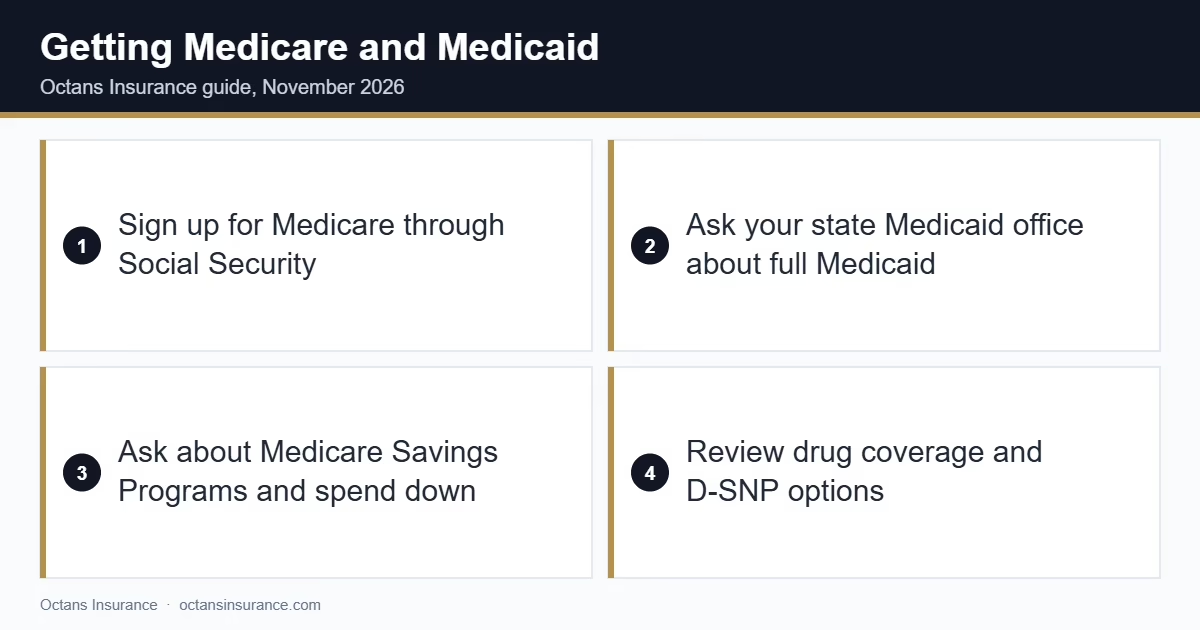
- Sign up for Medicare through Social Security. Online is the easiest and fastest way. If you already get Social Security or Railroad Retirement Board benefits, you’ll get Part A automatically. Our guide on when to enroll in Medicare covers the deadlines.
- Contact your state Medicaid office if your income and savings are limited. Ask to be checked for full Medicaid and for each Medicare Savings Program.
- Ask which documents to bring, such as proof of your income and savings.
- Ask about spend down if your income is just over your state’s limit.
- Review your drug coverage once you’re approved. With full Medicaid, you’ll be enrolled in a Medicare drug plan and get Extra Help. You can compare plans, including D-SNPs, where you live.
Questions to ask your state Medicaid office:
- Do I qualify for full Medicaid, a Medicare Savings Program, or both?
- Which income and resources count in this state, and which don’t?
- Does this state allow spend down?
- Which long-term care services can I get at home here?
- How does estate recovery work here, and how do I ask for a hardship waiver?
In Massachusetts, see our guide to help paying Medicare costs in Massachusetts.
Medicare vs Medicaid frequently asked questions
What is the main Medicare and Medicaid difference?
Eligibility is the main Medicare vs Medicaid difference. Medicare is based on age or disability, and anyone 65 or older can get it, whatever their income. Medicaid is based on financial need, with income and resource rules set by each state. Medicare has set premiums and deductibles, while Medicaid limits most cost sharing to nominal amounts and covers long-term nursing home care, which Medicare doesn’t.
Should older adults apply for Medicare or Medicaid?
Often both. Medicare is open to anyone 65 or older, and signing up for Part B late can mean a late enrollment penalty unless you have qualifying coverage, such as a plan from a current job. If your income and savings are limited, also apply for Medicaid through your state. Having both can lower what you pay for Medicare.
Is Extra Help part of Medicare or Medicaid?
Extra Help is a Medicare program. It helps people with limited income and resources pay Medicare drug coverage costs. You get it automatically if you have full-benefit Medicaid, get help paying your Part B premiums from a Medicare Savings Program, or receive Supplemental Security Income (SSI). So Medicaid can qualify you, but the help itself comes through Medicare drug coverage.
Does Medicaid pay Medicare premiums?
It can. Through the Medicare Savings Programs, your state may pay your Part B premium, which is $202.90 a month in 2026. The QMB program also pays Part A premiums if you owe them, plus Medicare deductibles and coinsurance. If you have full Medicaid, most of your Medicare costs will be covered. Your state Medicaid office handles applications.
Can you buy a Medigap policy if you have Medicaid?
Generally, no. Insurance companies generally can’t sell you a Medigap policy if you have Medicaid, and Medicare’s Medigap guide lists selling one to someone they know has Medicaid as illegal, except in limited situations. If you have both programs, a Dual Eligible Special Needs Plan is one way to coordinate your Medicare and Medicaid coverage.
Does Medicare or Medicaid pay for a nursing home?
Both, but for different stays. Medicare covers short-term skilled nursing care after an inpatient hospital stay of at least 3 days in a row. In 2026 you pay $217 a day for days 21 to 100 in a benefit period, and Medicare pays nothing after day 100. Medicare doesn’t pay for long-term custodial care. Medicaid covers nursing facility services if you meet your state’s rules.

How a licensed Octans agent can help
If you’re sorting out Medicare vs Medicaid, a licensed Octans agent can explain how Medicare plans work alongside Medicaid and compare Medicare Advantage plans in your area, including D-SNPs where they’re offered. If a Medicare Savings Program might lower your costs, we’ll point you to your state’s application. Call (617) 935-9220.
We don’t decide Medicaid eligibility; only your state Medicaid office can. For long-term care planning or estate recovery questions, talk with an elder law attorney.
For unbiased help, your State Health Insurance Assistance Program (SHIP) offers free counseling, and you can call 1-800-MEDICARE (1-800-633-4227) 24 hours a day, 7 days a week.
Keep Reading: Related Guides
- Medicare Savings Programs explained
- Medicare special needs plans
- Medicare Extra Help
- How to Sign Up for Medicare
- Medicare Part A
- Medicare Part B
- Does Medicare Cover Long Term Care?
- Medicaid Spend Down
- Medicaid Estate Recovery
We do not offer every plan available in your area. Please contact Medicare.gov or 1-800-MEDICARE to get information on all of your options.
This article is for general information and is not tax, legal, or medical advice.
About examples and tools: Hypothetical examples, sample rates, calculators and quizzes on this site are for general educational and illustrative purposes only. They are not quotes, offers of coverage, or guarantees of eligibility, approval, price or benefits, and they are not legal, tax, financial or medical advice. The insurance company decides eligibility and price; Medicare rules are set by CMS and the Social Security Administration. Octans Insurance is not connected with or endorsed by the U.S. government or the federal Medicare program.
Get help with Medicare and Medicaid choices
Start with a free, no-obligation quote review with a licensed Octans agent.
(617) 935-9220 | life@octansinsurance.com