
Medicaid Basics
Medicaid Estate Recovery: Who It Affects and What It Can Take
Medicaid estate recovery lets your state seek repayment from an estate after death. Learn who is exempt, what counts as the estate in four states and why your beneficiary forms matter.
- Federal law requires states to seek recovery for nursing facility and home and community-based care received at 55 or older.
- States can’t recover while a spouse, a child under 21 or a blind or disabled child survives.
- Medicare cost sharing paid through a Medicare Savings Program isn’t recoverable, New Jersey notes, since January 1, 2010.
- Texas won’t collect on life insurance that names a person, or when an estate is worth $15,000 or less.
Table of Contents
Make sure your family is financially protected today!
Medicaid estate recovery is a federal rule that requires states to seek repayment, after death, from the estates of certain people who got Medicaid, mainly people 55 or older who received nursing home or other long-term care. States can’t recover while a spouse, a child under 21 or a blind or disabled child survives. What counts as the estate varies by state.
What is Medicaid estate recovery?
Medicaid estate recovery is how a state gets back some of the money it paid for a person’s care. Under 42 U.S.C. 1396p(b), states generally can’t recover Medicaid that was correctly paid, except in the cases the law lists. For those cases, the state “shall seek” recovery. It isn’t optional.
Recovery generally comes from the person’s estate after death. It isn’t a penalty for doing anything wrong; the law describes it as recovering Medicaid that was correctly paid. States run it through their own offices or contractors. Texas, for example, calls its version the Medicaid Estate Recovery Program (MERP).
The federal rules set the floor. Each state then writes its own Medicaid estate recovery rules on which services it recovers for, what counts as the estate and how hardship waivers work. That’s why two families in different states can face very different claims.

Who does Medicaid estate recovery apply to?
According to Medicaid.gov and the statute, estate recovery reaches these groups:
- People 55 or older: states must seek recovery for nursing facility services, home and community-based services, and related hospital and prescription drug services. Nursing home and home-based long-term care are costs Medicare generally doesn’t pay.
- Other services, at the state’s option: states may also recover for other Medicaid services given at 55 or older.
- People of any age in a medical institution: if the state placed a lien on the home of someone who wasn’t expected to return home, it must seek recovery from the estate or from the sale of the property.
One exception matters to many people with Medicare. States can’t recover the Medicare cost sharing Medicaid paid for people in a Medicare Savings Program. New Jersey’s guide says this has been true since January 1, 2010. So if Medicaid only paid your Medicare premiums and cost sharing through a Medicare Savings Program, that help isn’t part of an estate claim.
What counts as the estate in Medicaid estate recovery?
At minimum, the estate is everything in the person’s probate estate under state law, meaning property that passes through the probate court. States may choose a broader definition. The statute lets them include any property the person had legal title to or an interest in at death, including property passed to survivors through:
- joint tenancy or tenancy in common;
- survivorship rights;
- a life estate;
- a living trust; or
- “other arrangement.”
A 2005 report by HHS’s Office of the Assistant Secretary for Planning and Evaluation (ASPE) explains the split. Some states use the narrow, probate-only definition. Others define the estate broadly to reach property that passes directly to a survivor, heir or assignee, which ASPE says can include annuity remainder payments or life insurance payouts.
Can Medicaid estate recovery take life insurance?
It depends on who gets the money and how your state defines the estate. Medicaid estate recovery life insurance rules differ from state to state.
- Texas says it won’t collect on “life insurance policies that name a person to receive the payment,” or on bank accounts paid on death to another person.
- New Jersey treats life insurance proceeds as the assets of the named beneficiaries. But proceeds are recoverable when they’re paid to the estate, whether the estate was named or became the beneficiary by default, such as when the named beneficiary died first.
- Massachusetts and Michigan define the estate as property in the probate estate.
New Jersey adds a caution: proceeds from whole life policies are subject to recovery if the policy wasn’t cashed in before death as Medicaid rules required. Whether a policy counts as an asset when you apply is a separate question. Our state guides, such as Texas Medicaid burial rules and New Jersey Medicaid burial rules, cover that.
The practical lesson: beneficiary forms matter. A policy that names a living person can be treated very differently from one that pays the estate. Our guides to the life insurance beneficiary and primary vs contingent beneficiaries explain how designations work. Ask an elder law attorney how your state’s rules apply to you.
When can’t the state recover?
Federal law builds in several protections:
- Survivors: recovery can happen only after the death of any surviving spouse, and only when there’s no surviving child under 21 or blind or disabled child. New Jersey’s guide says repayment is postponed until a child turns 21 or the spouse or child dies.
- Liens during life: a state may place a lien on the home of someone permanently in a nursing facility, but not if a spouse, a child under 21, a blind or disabled child, or a sibling with an equity interest lives there. The lien must be removed if the person is discharged and returns home.
- Family caregivers: after death, a state can’t recover from a liened home while a sibling who lived there a year before admission, or a son or daughter who lived there two years and provided care, still lives there.
- Hardship: states must have procedures to waive recovery when it would cause an undue hardship.
Texas gives examples of hardship: estate property that was a family business, farm or ranch for at least 12 months and is the heirs’ main income; heirs who would need government help if the state filed a claim; and a person who got services as a crime victim. Texas also may not ask for money back on a homestead worth under $150,000 if an heir’s family income is below a set level.

How Medicaid estate recovery rules vary by state
Here’s how four of the 19 states Octans serves describe their estate recovery program on official pages.
| State | What it recovers for | What counts as the estate | Other rules |
|---|---|---|---|
| Massachusetts | Care at 55 or older: nursing facility, home and community-based, and related hospital and drug services for which recovery is mandated | The probate estate | These limits apply to estates of people who died on or after Aug. 1, 2024; nursing facility residents of any age are also covered |
| Michigan | Long-term care services after September 30, 2007, for people 55 or older | Assets that pass through probate court | Heirs have 60 days from the letter to file an Undue Hardship Application |
| New Jersey | All Medicaid payments for services on or after age 55, including payments to managed care plans | Broad: the home or a share of it, bank accounts held alone or jointly, trusts, annuities and other property | Leftover money in an irrevocable funeral trust or burial policy goes to the state after reasonable funeral costs |
| Texas | Long-term care services and supports received after 55, if they began after March 1, 2005 | Excludes life insurance that names a person and payable-on-death bank accounts | No claim if the estate is $15,000 or less, or Medicaid costs are $5,000 or less |
Sources: Massachusetts General Laws, chapter 118E, section 31; Michigan DHHS estate recovery brochure (rev. February 2025); New Jersey DMAHS, The New Jersey Medicaid Program and Estate Recovery (rev. October 2017); Texas HHS, Your Guide to the Medicaid Estate Recovery Program (as of November 2026). Texas says MERP operations moved to a contractor, Stellarware Corporation, effective Sept. 1, 2026.
What could estate recovery take from a family?
Hypothetical example: Walter, 79, lived in Texas. He began getting Medicaid nursing facility care at 77, and Medicaid paid $96,000 for it. He was a widower, and his two children are adults without disabilities. When he died, he had $14,000 in a checking account in his name alone and a $40,000 retiree group life insurance policy with no cash value.
- If the policy named his daughter: Texas won’t collect on life insurance that names a person. His estate is the $14,000 account, and Texas won’t ask for money when an estate is worth $15,000 or less. His family keeps all $54,000 ($14,000 + $40,000).
- If the policy paid his estate (because he named the estate, or his only named beneficiary died first): his estate would be $54,000, well over the $15,000 line. Texas could then seek repayment of the $96,000 from what’s left of the $54,000 after estate debts, since Texas says debts such as funeral and legal costs are paid before a MERP claim.
Same family, same policy, and a gap of up to $54,000, driven by one beneficiary form. Real cases also involve funeral bills, debts and court costs, and rules differ by state, so the numbers here are only an illustration.
How to handle a Medicaid estate recovery notice
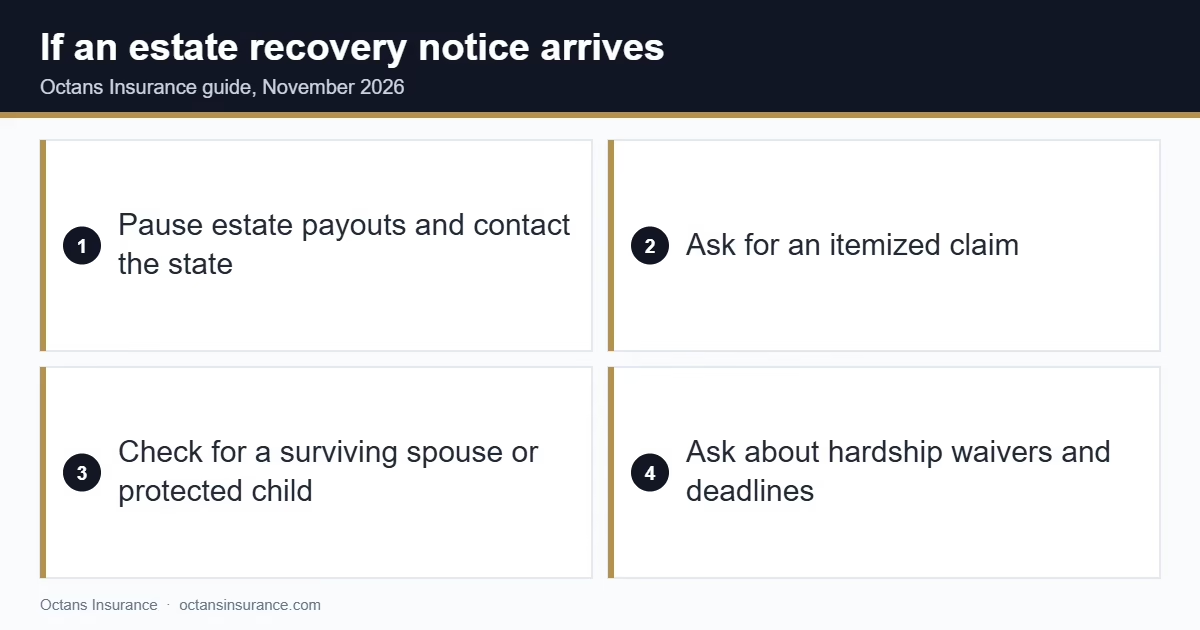
- Pause before paying out the estate. New Jersey, for example, says whoever handles the estate must contact the state before spending estate funds, except for reasonable funeral expenses.
- Ask for an itemized claim. Check that it covers only services your state can recover for, and that Medicare Savings Program help isn’t included.
- Check who survives. A spouse, a child under 21 or a blind or disabled child means the state must wait.
- List what’s in the estate under your state’s definition, and what passed outside it.
- Ask about hardship waivers and deadlines. Texas uses Form 5006, and Michigan gives heirs 60 days to apply.
- Talk to an elder law or probate attorney before you sign or pay anything.
Questions to ask the state’s estate recovery office:
- Which services and dates does the claim include?
- Does the state use a probate-only or a broader estate definition?
- Can funeral costs be paid first?
- Is there a small-estate threshold or cost-effectiveness rule?
- How do we apply for a hardship waiver, and by when?
Medicaid estate recovery frequently asked questions
Can Medicaid take my house after I die?
It can if the house is part of your estate under your state’s rules and no exception applies. The state must wait while a spouse, a child under 21 or a blind or disabled child survives. Liened homes also have protections for some siblings and caregiving children who live there, and states must offer hardship waivers. Texas may not seek recovery on a homestead under $150,000 for some low-income heirs.
Does estate recovery apply to Medicare?
Estate recovery is a Medicaid rule under 42 U.S.C. 1396p. It covers benefits Medicaid paid, not care Medicare paid for. Even within Medicaid, states can’t recover the Medicare cost sharing paid for people in a Medicare Savings Program. If you have both Medicare and full Medicaid, recovery can apply to the Medicaid long-term care you received at 55 or older.
Is life insurance protected from estate recovery?
Usually, if it pays a living, named beneficiary, though state rules decide. Texas won’t collect on policies that name a person, and New Jersey treats those proceeds as the beneficiary’s. Proceeds paid to the estate, including by default when a beneficiary died first, can be recovered in New Jersey. States with broad estate definitions can reach some property outside probate.
Do children have to pay back Medicaid?
The claim is against the person’s estate, not a bill for heirs’ own money. Heirs may receive less, though: New Jersey, for example, bars payouts to heirs until the state’s claim is repaid. In states with broad definitions, property that passed to heirs outside probate, such as through joint ownership, can count as part of the estate. An elder law attorney can review a specific claim.
When does a state make an estate recovery claim?
Only after the Medicaid enrollee dies, and only when no surviving spouse, child under 21 or blind or disabled child is living. If one is, the claim is postponed, not erased. New Jersey, for example, says it can recover from remaining estate assets later, once the spouse dies or the child turns 21.

How a licensed Octans agent can help
Octans doesn’t handle estate recovery claims or decide Medicaid eligibility. A licensed Octans agent can review the life insurance you already own, explain how beneficiary designations work and help you update them with the insurance company. Call (617) 935-9220.
If you’re planning for funeral costs, final expense insurance is one option among others, such as savings or a funeral arrangement your state’s Medicaid rules allow. We can explain how each works. For estate plans, transfers or a claim you’ve received, talk with an elder law attorney, and contact your state Medicaid agency with questions about a specific case.
Keep Reading: Related Guides
- Medicare vs Medicaid
- Life insurance beneficiaries
- MassHealth life insurance and burial rules
- Medicaid Spend Down
- Does Medicare Pay for Funeral Costs? What Families Can Use Instead
Important: Octans Insurance agents are licensed in the states in which they operate. Coverage availability and rates may vary by state. Premium examples, when provided, are illustrative samples from published sources, not quotes. Final rates are determined by the insurance carrier based on underwriting and applicable policy criteria. Policy terms, exclusions, limitations, riders, and availability vary by carrier and state.
About examples and tools: Hypothetical examples, sample rates, calculators and quizzes on this site are for general educational and illustrative purposes only. They are not quotes, offers of coverage, or guarantees of eligibility, approval, price or benefits, and they are not legal, tax, financial or medical advice. The insurance company decides eligibility and price; Medicare rules are set by CMS and the Social Security Administration.
Review your life insurance beneficiaries with an agent
Start with a free, no-obligation quote review with a licensed Octans agent.
(617) 935-9220 | life@octansinsurance.com