
Medicare Eligibility
Medicare for Green Card Holders: Costs and the 5-Year Rule
Medicare for green card holders depends on your work record and how long you’ve lived here. Here’s how the 5-year rule, spouse credits and the 2025 law affect when you can enroll.
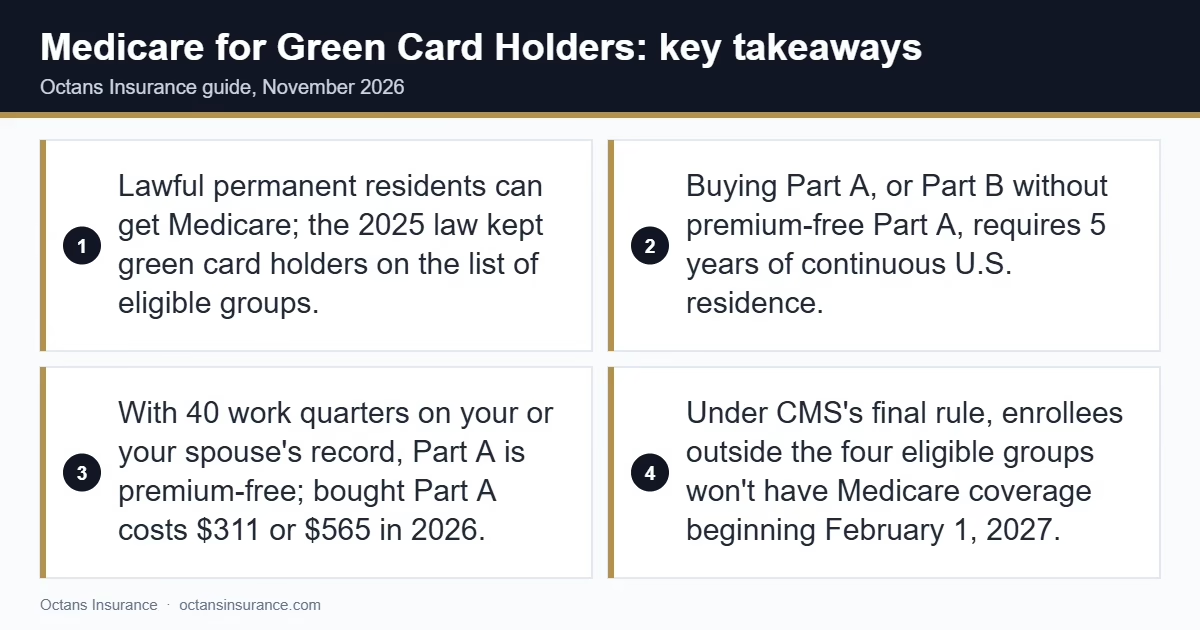
- Lawful permanent residents can get Medicare; the 2025 law kept green card holders on the list of eligible groups.
- Buying Part A, or Part B without premium-free Part A, requires 5 years of continuous U.S. residence.
- With 40 work quarters on your or your spouse’s record, Part A is premium-free; bought Part A costs $311 or $565 in 2026.
- Under CMS’s final rule, enrollees outside the four eligible groups won’t have Medicare coverage beginning February 1, 2027.
Table of Contents
Make sure your family is financially protected today!
Medicare for green card holders works much like it does for citizens: lawful permanent residents 65 or older can get Medicare. If you or your spouse earned enough work credits, Part A is usually premium-free. If not, you can buy Part A and Part B once you’ve lived in the U.S. for 5 years in a row. Bought Part A costs $311 or $565 a month in 2026.
Can green card holders get Medicare?
Yes. Medicare.gov says you must be a U.S. citizen or national, a lawful permanent resident (green card holder), a Cuban-Haitian entrant, or a Compact of Free Association (COFA) migrant lawfully living in the U.S. to get Part A and Part B or join a Medicare health or drug plan. Green card holders are on that list.
Medicare for permanent residents then follows one of two paths:
- The work path. If you or your spouse worked long enough in the U.S. and paid Medicare taxes, you can get Part A without a premium at 65, like a citizen.
- The residence path. If you don’t qualify for premium-free Part A, you can buy Part A and Part B at 65 or older once you’ve lived in the U.S. continuously for 5 years.
Your status isn’t what sets your price. Your work record does. Our Medicare eligibility guide covers the general age, disability and work rules. This page is also available in Spanish: Medicare para residentes permanentes.
Medicare for green card holders: the 5-year residence rule
The 5-year rule applies when you buy Medicare instead of earning it. Federal rules require a permanent resident who buys Part A, or who enrolls in Part B without premium-free Part A, to have lived in the U.S. continuously for the 5 years right before applying.
- Buying Part A: under 42 CFR 406.20, you must be 65 or older, live in the U.S., have 5 years of continuous residence, not qualify for premium-free Part A, and have Part B or sign up for it during an enrollment period.
- Part B alone: 42 CFR 407.10 lets anyone 65 or older who lives here buy Part B if they’re a citizen or a permanent resident with the same 5 years of continuous residence.
- With premium-free Part A: the same rule lets anyone entitled to premium-free Part A enroll in Part B. So if you qualify on your own or your spouse’s work record, the 5-year wait doesn’t apply.
The 5 years can start before your green card. Social Security’s manual, POMS HI 00805.005, says the continuous residence may begin before lawful permanent residence is granted. Keep records that show when you started living here.
Timing matters for penalties. Your Part B initial enrollment period is the 7-month window around the month you first meet the rules. In Medicare for green card holders over 65, the window can center on the month you reach 5 years of residence, not your 65th birthday.
Do green card holders get premium-free Part A?
Many do, because Medicare for permanent residents uses the same work rule as for citizens. About 99% of people with Medicare don’t pay a Part A premium because they have at least 40 quarters of Medicare-covered work, according to CMS.
Work credits add up by earnings. In 2026, you earn one credit for each $1,890 of covered earnings, and in 2027 it takes $1,970, according to Social Security’s quarter of coverage table. No matter how much you earn, you can get at most 4 credits a year, so 40 credits take at least 10 years of work.
Your spouse’s work can count, too. Social Security says you can get premium-free Part A at 65 if your spouse, living or deceased, including a divorced spouse, receives or is eligible to receive Social Security or Railroad Retirement Board benefits. Social Security decides whether you qualify on a spouse’s record.
What does Medicare for green card holders cost in 2026?
Medicare for green card holders costs the same as for citizens with the same work record. Your Part A premium depends on how many quarters of Medicare-covered work you or your spouse have, and Part B has one standard rate.
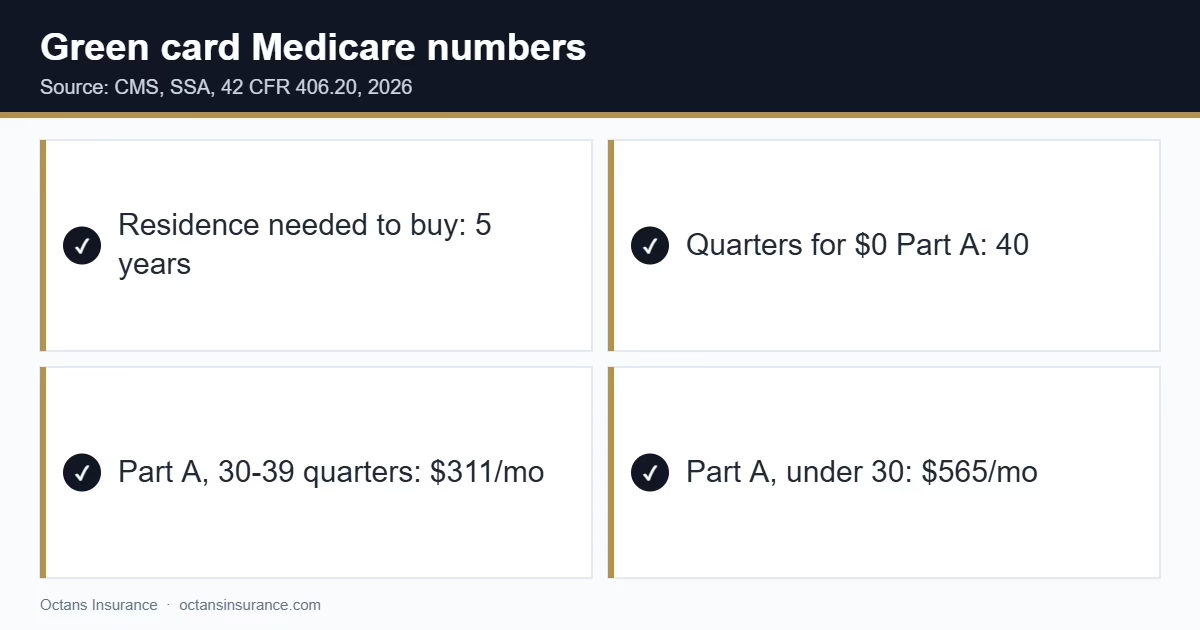
| Your or your spouse’s work record | Part A premium, 2026 | Part B premium, 2026 |
|---|---|---|
| 40 or more quarters | $0 | $202.90 a month (standard) |
| 30 to 39 quarters | $311 a month | $202.90 a month (standard) |
| Fewer than 30 quarters | $565 a month | $202.90 a month (standard) |
Source: CMS, 2026 Medicare Parts A and B premiums and deductibles (Nov. 14, 2025). In 2026, the Part A deductible is $1,736 per benefit period and the Part B deductible is $283. Part B can cost more at higher incomes. CMS announces 2027 amounts in the fall; check Medicare.gov.
Three rules shape the decision:
- Part A needs Part B. Medicare.gov says you also have to sign up for Part B to buy Part A.
- Part B can stand alone. If you aren’t eligible for premium-free Part A, Social Security says you can buy Part B without buying Part A.
- Waiting can cost more. If you must buy Part A and don’t when first eligible, your premium may go up 10% for twice the number of years you didn’t sign up. The Part B late enrollment penalty adds 10% for each year you could have had Part B but didn’t, usually for as long as you have it.
How did the 2025 law change Medicare for immigrants?
The biggest recent change to Medicare for immigrants came in 2025. A federal law, Pub. L. 119-21, signed July 4, 2025, added section 1899C to the Social Security Act. It says a person may get or keep Medicare only if they are:
- a U.S. citizen or national;
- a lawful permanent resident;
- a Cuban and Haitian entrant; or
- a person lawfully living in the U.S. under a Compact of Free Association.
Green card holders keep their eligibility, and CMS notes the law didn’t remove the 5-year residence rule for permanent residents who buy Medicare. The change affects Medicare for immigrants with other lawful statuses, such as refugees or asylees who haven’t become permanent residents.
For people already enrolled on July 4, 2025, the law says the limit applies 18 months after that date. It gave Social Security one year to review current enrollees and requires it to notify anyone whose coverage will end.
On Nov. 4, 2026, CMS announced final rules to carry this out, including termination procedures, appeal rights and enrollment options for people who later gain or regain eligibility. Under the final rule, Social Security sends termination notices in December 2026, and people who can’t show they’re eligible won’t have Medicare coverage beginning February 1, 2027. If you get a notice, contact Social Security right away. For questions about your immigration status, talk with an immigration attorney.
How a spouse’s work record can change the math
Hypothetical example: Elena turns 65 in 2026. She moved to the U.S. and got her green card in 2023 to join Jorge, 67, her husband of 30 years, a U.S. citizen who worked here for 35 years and gets Social Security. Elena has no U.S. work credits.
- Using Jorge’s record: because Jorge receives Social Security, Elena may get premium-free Part A at 65 on his record, if Social Security confirms she qualifies as his spouse. With premium-free Part A, she can enroll in Part B right away, without waiting for 5 years of residence.
- Her 2026 cost: $202.90 a month for Part B, or $2,434.80 a year, plus the $283 Part B deductible when she uses Part B care.
- Without Jorge’s record: she couldn’t buy Medicare until she had 5 years of continuous residence, in 2028. At 2026 rates, Part A would then cost $565 a month ($6,780 a year), plus $2,434.80 for Part B, or $9,214.80 a year.
In this example, the spouse’s record means Medicare starts about two years sooner and costs $6,780 less a year at 2026 rates. For couples, this is often the biggest money question in Medicare for green card holders.
How to apply for Medicare as a green card holder
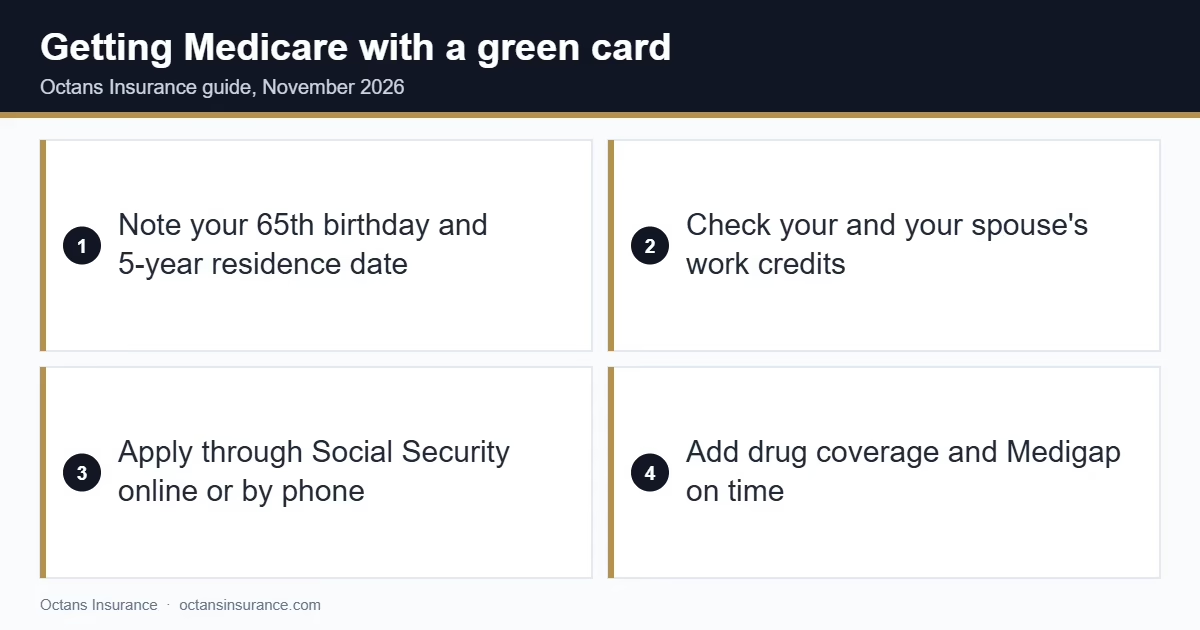
- Find your dates. Note your 65th birthday, the month you started living in the U.S. and the month you’ll reach 5 years of continuous residence.
- Check work credits for you and your spouse, since 40 credits on either record can mean premium-free Part A.
- Decide what to sign up for: Part A and Part B, or Part B alone if you’d have to buy Part A.
- Apply through Social Security. Its Medicare booklet says you can apply online, call 1-800-772-1213 (TTY 1-800-325-0778), or ask for a video, phone or in-person appointment.
- Send original documents or certified copies. Social Security says copies must be certified by the agency that issued them.
- Add other coverage on time, such as a drug plan and, if you want one, a Medigap policy or Medicare Advantage plan.
Applying for Medicare for green card holders works the same way as for citizens. Our step-by-step guide to how to sign up for Medicare covers each enrollment window in more detail.
Medigap, Medicare Advantage and drug plans for permanent residents
Once you have Medicare, your plan choices are the same as a citizen’s. To join a Medicare Advantage plan, you need both Part A and Part B and must live in the plan’s service area. To join a drug plan, you need either Part A or Part B.
If you want a Medigap policy, timing matters. Your 6-month Medigap open enrollment period starts the first month you have Part B and are 65 or older. This is a key point in Medicare for green card holders over 65 who qualify late: if you first get Part B at 68 because that’s when you met the 5-year rule, your open enrollment starts then.
Don’t skip drug coverage. If you go 63 or more days in a row without Medicare drug coverage or other creditable coverage after your initial enrollment period, you may owe a late enrollment penalty. If money is tight, ask about Extra Help and Medicare Savings Programs.
Questions to ask Social Security before you apply:
- How many work credits do I have, and does my spouse’s record qualify me for premium-free Part A?
- When does my 5-year residence period end, and when does my enrollment period start?
- What documents prove my status and residence?
- Will I owe a late enrollment penalty if I wait?
Medicare for green card holders: frequently asked questions
Can I get Medicare if I’ve had a green card for less than 5 years?
Yes, in some cases. The 5-year residence rule applies when you buy Part A or enroll in Part B without premium-free Part A. If you or your spouse have enough work credits for premium-free Part A, you can get Part A and then Part B. If you’d have to buy Medicare, you must wait until you’ve lived here 5 years in a row.
Do green card holders pay more for Medicare?
No. Medicare for permanent residents is priced like it is for citizens, and premiums don’t depend on immigration status. Part A is premium-free with 40 quarters of work on your or your spouse’s record, or $311 or $565 a month in 2026 if you buy it. The standard Part B premium is $202.90 a month in 2026, and higher incomes pay more.
Can green card holders join a Medicare Advantage plan?
Yes. Lawful permanent residents can join a Medicare Advantage plan or a Part D drug plan on the same terms as citizens. You need Part A and Part B for a Medicare Advantage plan, and Part A or Part B for a drug plan. You must also live in the plan’s service area. Extra benefits vary by plan and area.
Does the 2025 law take Medicare away from green card holders?
No. Pub. L. 119-21 keeps Medicare open to lawful permanent residents, along with citizens, nationals, Cuban and Haitian entrants and COFA residents. People in other statuses who were already enrolled on July 4, 2025 lose eligibility under the law. CMS’s final rule says those who can’t show they’re eligible won’t have Medicare beginning February 1, 2027, and it includes appeal rights.
Can I count the years I lived here before my green card?
Possibly. Social Security’s manual says the 5 years of continuous residence may begin before you were granted lawful permanent residence. Social Security decides based on your records, so keep proof of where you lived, such as leases, bills or tax records. Ask Social Security how it will count your time.

How a licensed Octans agent can help
Social Security decides who qualifies for Medicare; Octans doesn’t. If you’re sorting out Medicare for green card holders in your family, start there. Once you know your start date, a licensed Octans agent can explain your choices, including Medigap, Medicare Advantage and Part D plans available where you live, and help you avoid gaps that lead to penalties. Octans works in 19 states. Call (617) 935-9220.
We can also show how your Part A premium tier changes your yearly cost, and walk you through the decision in plain language.
For unbiased help, your State Health Insurance Assistance Program (SHIP) offers free one-on-one counseling, and you can call 1-800-MEDICARE (1-800-633-4227) 24 hours a day, 7 days a week.
Keep Reading: Related Guides
We do not offer every plan available in your area. Please contact Medicare.gov or 1-800-MEDICARE to get information on all of your options.
This article is for general information and is not tax, legal, or medical advice.
About examples and tools: Hypothetical examples, sample rates, calculators and quizzes on this site are for general educational and illustrative purposes only. They are not quotes, offers of coverage, or guarantees of eligibility, approval, price or benefits, and they are not legal, tax, financial or medical advice. The insurance company decides eligibility and price; Medicare rules are set by CMS and the Social Security Administration. Octans Insurance is not connected with or endorsed by the U.S. government or the federal Medicare program.
Get help choosing coverage once you qualify
Start with a free, no-obligation quote review with a licensed Octans agent.
(617) 935-9220 | life@octansinsurance.com